
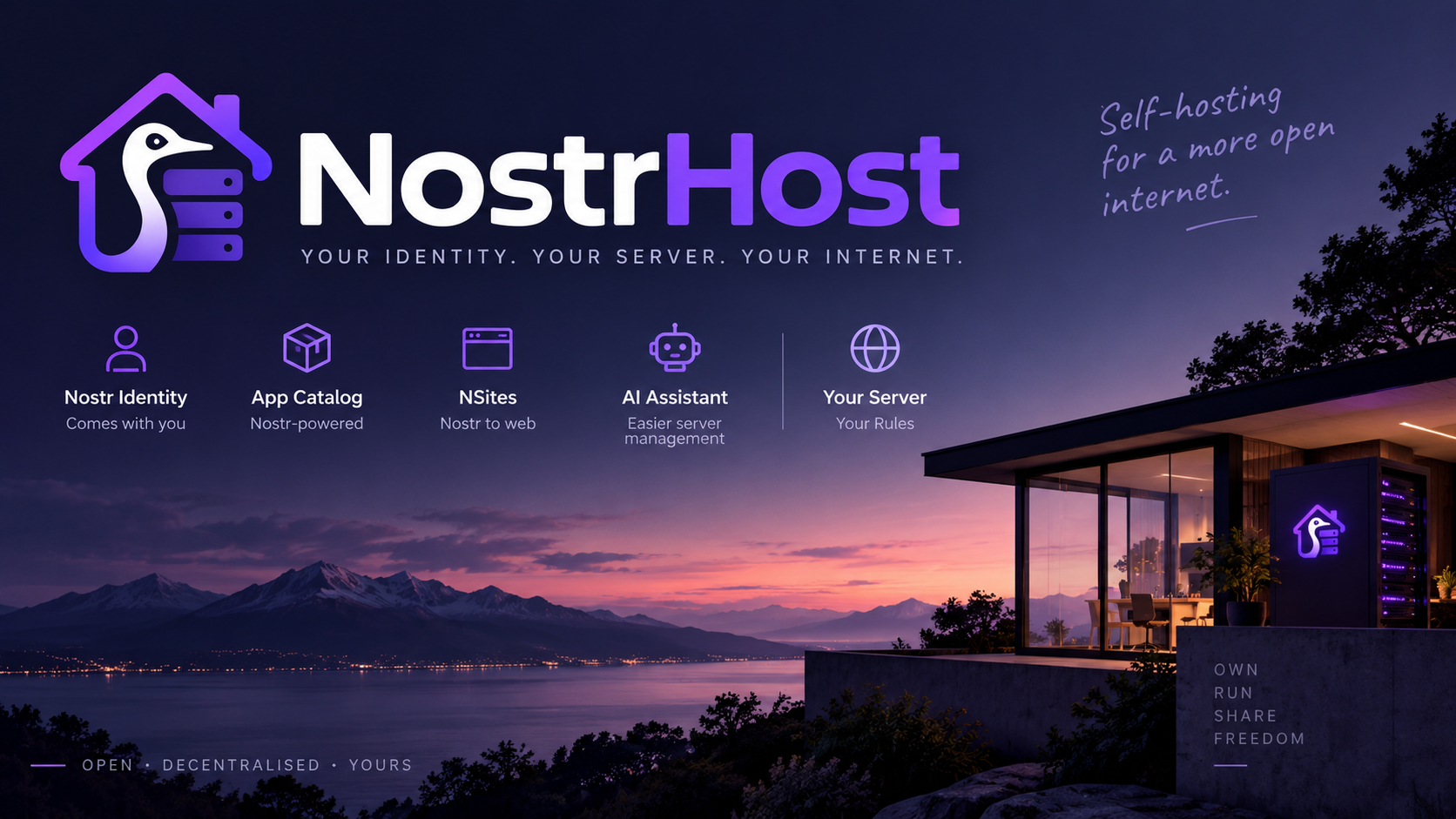
What would self-hosting look like if Nostr identity and modern AI were there from the beginning?
<br />
That's the question behind NostrHost.
<br />
NostrHost is a Nostr-focused self-hosting platform designed to make running your own internet services simpler, with your Nostr identity at its centre and AI increasingly helping with administration.
<br />
It's early. It's evolving quickly. And I'm looking for people who want to help test it, break it and build it.
<br />
Self-hosting, reconsidered
<br />
Self-hosting gives us something increasingly valuable: control over the services we use and where they run.
<br />
But that control traditionally comes with a price.
<br />
You have to run the server.
<br />
Projects such as YunoHost have made that dramatically easier by turning many server administration tasks into something that can be managed through a web interface.
<br />
NostrHost asks what the next step might look like.
<br />
What if your existing Nostr identity was understood by the server?
<br />
What if Nostr applications could be discovered and installed through Nostr?
<br />
What if Nostr-native websites could be installed like any other application and made available on the regular web?
<br />
And what if, instead of learning how to administer everything yourself, you could increasingly just tell an AI what you wanted your server to do?
<br />
That's what NostrHost is exploring.
<br />
What does that actually look like?
<br />
The goal is surprisingly simple.
<br />
Open NostrHost.
<br />
Browse the built-in application catalogue.
<br />
Find an application you want.
<br />
Install it.
<br />
It appears in your portal alongside your other services.
<br />
Behind that simple experience, though, NostrHost is starting to work differently from a conventional self-hosting platform.
<br />
Nostr isn't just another application running on the server. It's becoming part of how the platform itself works.
<br />
It started with YunoHost
<br />
NostrHost didn't begin as an attempt to build another self-hosting platform.
<br />
I was using YunoHost and started experimenting with bringing more Nostr applications into it.
<br />
That led to packaging Nostr apps.
<br />
Then I built a Nostr-based application catalogue.
<br />
Then came experiments with Nostr authentication and tools that allowed AI agents to help manage the server.
<br />
Each project raised another question.
<br />
If Nostr can provide identity, why maintain a completely separate identity system?
<br />
If applications can be discovered through Nostr, why does the catalogue need to work entirely like a traditional app store?
<br />
If AI can install, configure, test and troubleshoot applications, how much server administration does the person running the server actually need to do?
<br />
Eventually, these stopped looking like additions to YunoHost.
<br />
They started looking like a different approach to self-hosting.
<br />
So I forked YunoHost and started NostrHost.
<br />
Your identity comes with you
<br />
One of the biggest differences is also one of the simplest.
<br />
Normally, when you install a new service, you create another account.
<br />
Your server has users. Applications have users. Websites have users. Each system needs some way of deciding who you are.
<br />
Nostr already gives you an identity.
<br />
NostrHost is being designed around that fact.
<br />
Instead of:
<br />
"Create an account on my server."
<br />
The model becomes closer to:
<br />
"This is me."
<br />
Your identity doesn't originate with the server. It belongs to you.
<br />
The server and the applications running on it can increasingly recognise that identity rather than each creating another version of you.
<br />
For self-hosting, that feels like a much more natural starting point.
<br />
The Nostr Catalog is built in
<br />
Applications are still at the centre of NostrHost.
<br />
But application discovery can work differently.
<br />
The Nostr Catalog is built directly into NostrHost, allowing Nostr applications to sit alongside other applications and be installed from the same place.
<br />
For the person using NostrHost, it should feel straightforward:
<br />
Find an app. Install it. Use it.
<br />
The difference is underneath.
<br />
Applications can be published and discovered through Nostr rather than depending entirely on a conventional central app catalogue.
<br />
That gives developers another way to distribute self-hosted Nostr software while keeping the experience familiar for the person installing it.
<br />
NSites blur the line between Nostr and the web
<br />
NSites show why this gets interesting.
<br />
An Nsite can sit alongside other applications in the NostrHost catalogue.
<br />
Install one and it appears in the NostrHost portal just like another application.
<br />
But NostrHost can also bridge it to the clearnet.
<br />
That means someone visiting the site doesn't necessarily need to understand Nostr, use a special client or know anything about how the content works underneath.
<br />
They can simply visit a normal web address.
<br />
From the NostrHost owner's perspective, the Nsite is simply another service their server handles.
<br />
That's the kind of experience I'm aiming for.
<br />
Nostr-native technology shouldn't necessarily feel unusual to use.
<br />
AI could change the self-hosting equation
<br />
Nostr is only half of this experiment.
<br />
The other half is AI.
<br />
Traditional self-hosting has always involved a trade-off.
<br />
You gain control over your services, but you also become responsible for keeping everything running.
<br />
The first generation of self-hosting platforms made this easier by replacing many command-line tasks with control panels and buttons.
<br />
AI could be the next step.
<br />
Instead of learning which button to press, you tell the server what you want.
<br />
"Install this application."
<br />
"Why isn't this working?"
<br />
"Update everything."
<br />
"Make this available to my family."
<br />
The goal is for AI to deal with more of the technical complexity behind those requests, while important actions remain under the owner's control.
<br />
That's the direction NostrHost is heading.
<br />
AI is already helping build it
<br />
This isn't entirely theoretical.
<br />
AI agents are already heavily involved in developing NostrHost and its surrounding ecosystem.
<br />
They can inspect code, implement changes, review work, investigate failures, test fixes, package applications and repeat the process when something doesn't work.
<br />
That has helped NostrHost evolve quickly.
<br />
There's an interesting symmetry to that.
<br />
AI is helping build a self-hosting platform designed so AI can eventually help people operate it.
<br />
The development process itself is testing some of the ideas that could eventually make self-hosting easier for everyone else.
<br />
Nostr where it makes sense
<br />
NostrHost isn't about replacing technology simply for the sake of decentralisation.
<br />
The test is much more practical:
<br />
Does using Nostr here make self-hosting better?
<br />
Portable identity makes sense.
<br />
Discovering Nostr applications through Nostr makes sense.
<br />
Using that identity across services makes sense.
<br />
Allowing Nostr-native content to reach the conventional web makes sense.
<br />
Using signed identity to help control important server actions makes sense.
<br />
Where traditional technology remains the better solution, there's little reason to replace it simply because something newer exists.
<br />
The aim isn't maximum decentralisation.
<br />
It's better self-hosting.
<br />
Nostr underneath, simplicity on top
<br />
There are substantial changes happening underneath NostrHost.
<br />
Authentication is changing. Server management is being redesigned. Conventional components inherited from YunoHost are being reconsidered or replaced. Nostr-native approaches are being introduced where they offer an advantage.
<br />
Ideally, most people shouldn't need to know about any of that.
<br />
A successful Nostr-focused self-hosting platform shouldn't require someone to understand every Nostr protocol any more than using a browser requires understanding HTTP.
<br />
You should be able to bring your identity, choose the applications you want and use them.
<br />
The complicated technology can stay underneath.
<br />
This is where I need help
<br />
NostrHost is still early.
<br />
It isn't a finished product, and I'm not pretending that it is.
<br />
Things will break.
<br />
Some ideas will work. Others will probably be thrown away and replaced. There are still plenty of decisions to make.
<br />
That's also why this is an interesting time to get involved.
<br />
NostrHost needs testers and contributors.
<br />
If you have a spare server or VM, use Nostr, package applications, develop software, work with AI or simply have opinions about how self-hosting should work, I'd like your help.
<br />
Install it.
<br />
Break it.
<br />
Tell me what's confusing.
<br />
Build something for it.
<br />
Tell me where the idea doesn't work.
<br />
Help shape what comes next.
<br />
You don't necessarily need to be deeply technical either. Feedback about what feels complicated, what doesn't make sense and what you'd expect NostrHost to do is just as useful.
<br />
Ultimately, this isn't really about building another Linux server distribution.
<br />
It's about returning to the question that started the project:
<br />
If we had Nostr identities, modern AI and everything we've learned from platforms like YunoHost available from day one, how would we design self-hosting today?
<br />
NostrHost is my attempt to find out.
<br />
Project: https://github.com/imattau/nostrhost