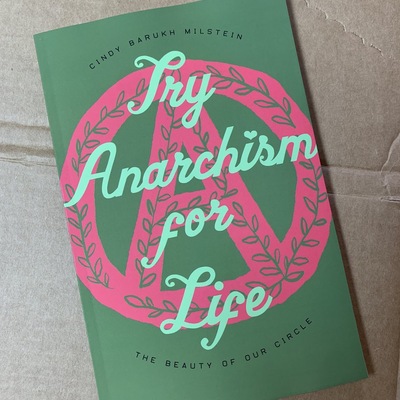
Misfit. Wordsmith. Dreamer. Rebel.
Never at home in this world, so always aspiring to make new ones with others.
Labors of love: creating books, doing care + grief care, curating magical do-it-ourselves + ritual spaces, people. 🖤❤️🌿
@cindymilstein on IG
cbmilstein.wordpress.com
#Anarchism #JewishAnarchism #Mazeldon #QueerAsFuck #AnarchaFeminism
#Solidarity #MutualAid #CollectiveCare #ArtOfResistance #PrefigurativePolitics #RebelliousMourning #ACAB #EverythingForEveryone #UntilAllAreFree
Public Key
npub1c2kpq4kyd6ulfwzgm4cx6en004arylh80yvphe8xl8mrghd4gv8srrdpz5 Profile Code
nprofile1qqsv9tqs2mzxaw05hpyd6urdvehh673j0mnhjxqmunn0na35tk65xrcpz3mhxue69uhhyetvv9ujuerpd46hxtnfduqs6amnwvaz7tmwdaejumr0dssn0kyh
Show more details
Published at
2026-08-14T00:38:45Z Event JSON
{
"id": "3dbf1c6629de7fbb7f015d2bf6cc6ceb72577d514df9c874395e0a25ab5b025a" ,
"pubkey": "c2ac1056c46eb9f4b848dd706d666f7d7a327ee779181be4e6f9f6345db5430f" ,
"created_at": 1786667925 ,
"kind": 0 ,
"tags": [
[
"t",
"anarchism"
],
[
"t",
"acab"
],
[
"t",
"solidarity"
],
[
"t",
"MutualAid"
],
[
"t",
"untilallarefree"
],
[
"t",
"anarchafeminism"
],
[
"t",
"EverythingForEveryone"
],
[
"t",
"CollectiveCare"
],
[
"t",
"prefigurativepolitics"
],
[
"t",
"queerasfuck"
],
[
"t",
"RebelliousMourning"
],
[
"t",
"ArtOfResistance"
],
[
"t",
"Mazeldon"
],
[
"t",
"JewishAnarchism"
],
[
"proxy",
"https://kolektiva.social/users/cbmilstein",
"activitypub"
],
[
"L",
"pink.momostr"
],
[
"l",
"pink.momostr.activitypub:https://kolektiva.social/users/cbmilstein",
"pink.momostr"
],
[
"-"
]
],
"content": "{\"name\":\"Cindy Milstein (they)\",\"about\":\"Misfit. Wordsmith. Dreamer. Rebel. \u2028Never at home in this world, so always aspiring to make new ones with others. \u2028Labors of love: creating books, doing care + grief care, curating magical do-it-ourselves + ritual spaces, people. 🖤❤️🌿\u2028\u2028@cindymilstein on IG\u2028cbmilstein.wordpress.com\u2029#Anarchism #JewishAnarchism #Mazeldon #QueerAsFuck #AnarchaFeminism\u2028#Solidarity #MutualAid #CollectiveCare #ArtOfResistance #PrefigurativePolitics #RebelliousMourning #ACAB #EverythingForEveryone #UntilAllAreFree\",\"website\":\"https://kolektiva.social/@cbmilstein\",\"picture\":\"https://kolektiva.social/system/accounts/avatars/000/014/437/original/50743e000ef3f4dd.jpeg\",\"banner\":\"https://kolektiva.social/system/accounts/headers/000/014/437/original/01e28409e8fda83d.jpeg\",\"nip05\":\"[email protected] \"}" ,
"sig": "82a94b26dd35792a271f8f2dfce1d8307896955fdbfad9845429abee40c0fbf73aa66430efd412499a0317a73bf3f96f27e3a56569c561e860d62b08b7956cb9"
}
Last Notes npub1c2kpq4kyd6ulfwzgm4cx6en004arylh80yvphe8xl8mrghd4gv8srrdpz5 Cindy Milstein (they) “Call for contributions” to the next zine in my curated series, “Side by Side” — sparked by my rage, horror, and grief at Tuesday’s cruel and sadistic sentencing of 30 years for my beloved friend @free.des.revol and 50-100 years for other Prairieland defendants. What the fuck / fuck the state / fuck the prisons and police! I was so utterly heartbroken when the sentences came down, I felt powerless that day. Then I realized that so many of us were instantly springing into motion—and already had been. Rather than powerless, first and foremost, we checked in on each other, sending messages of love and solidarity, especially to the defendants’ families and friends. Then we tirelessly leaped into all the many tasks of doing anti-repression “work,” as voluntary labors of love, that we anarchists do particularly well. Yesterday, when the sentences hit me even harder, having sunk in, I realized that we anarchists, especially those with deep experience doing anti-repression and prisoner solidarity, have a responsibility. It’s our duty to share the many hard-won lessons, our best anti-repression tools and tactics, especially for those new to state repression, so as to better aid them in making good decisions and keep more of us out of harm’s way, or at a minimum, not let anyone feel alone when repression hits. Collective defense doesn’t start when the indictments come down; it is a daily practice, particularly under fascism. It’s what keeps people from cooperating with the state and cops, and it’s what teaches people, as second nature, to have each others’ sides and backs. It’s what helps ward off despair and sustain our resolve. And so much more. SO, in honor of the noncooperating Prairieland defendants, being used as fodder for a death machine intent on making “antifascism” seem wrong and quelling all resistance, send me stories of the good/caring/effective tools and tactics you’ve used when doing anti-repression work. Length: 80 to 250 words, prose! Due: by July 4 (on the one-year anniversary of “fuck the government that fucked over our comrades on July 4, 2025”) Email to: cbmilstein [at] yahoo {dot} com #FreeThemAll (photo: tag seen in Exarcheia) Also at: https://www.instagram.com/p/DaAh3ETRRYz/ https://kolektiva.social/system/media_attachments/files/116/810/833/683/188/882/original/1da30eaf2f5c3517.png npub1c2kpq4kyd6ulfwzgm4cx6en004arylh80yvphe8xl8mrghd4gv8srrdpz5 Cindy Milstein (they) One would think, logically, that a “no kings” sentiment for Saturday’s rallies would make the connection to a “no cops” one too. After all, as the nursery rhyme goes, “All the king’s horses and all the king’s men”—perhaps a monarchical version of present-day police on horses, bikes, or motorcycles—can’t fix this broken world; indeed, they broke (and break) it! But sadly, this blandly passive-liberal day has, at least in terms of its key NGO promoters, tended to not only ignore the fact that “kings” need enforcers for their regimes but also that the “subjects” they’re urging to fill the streets on these Saturdays somehow need “policing” too. We wouldn’t want the peasantry to rise up, right? So whether police in blue or those in yellow, the No Kings’ top-down organizers have a vested interest in containing any sort of abolitionist sentiments. “Abolition,” to be worthy of its name, would, I’d contend, involve abolishing hierarchy and domination in all of its forms: presidents and their states, cops and courts, prisons and borders, electoral politics and nonprofits… So to all the riffraff and rabble-rousers, heretics and and other good troublemakers, if you’re planning to go to a “No Kings” stand-around-and-do-almost-nothing gathering, bring along your best “No’s” to kings, presidents, dictators, fascists … and police, among other collaborators with deadly social orders. Not that I’m advocating any specific self-organized actions, mind you. But that could look like blanketing the rallies with “Never, ever talk to cops”-type literature, stickers, banners, and buttons; doing DIY “workshops” on the streets that aim to educate folks that “We don’t talk to police” and how “We’d feel safer without police”; practicing forms of “We keep each other safe” while being ungovernable in direct contrast to any “peace police” striving to command-and-control; and other creative ideas that aid folks in breaking free of the myth that any type of police, as institutions of systemic violence, are good. (photos: “We don’t talk to police” sticker seen in Vienna, October 2025; “We’d feel safer without police” poster seen in Madison, WI, October 2025) #AllComradesAreBeautiful https://kolektiva.social/system/media_attachments/files/116/301/319/902/245/564/original/0f639b5c0b4067a7.png https://kolektiva.social/system/media_attachments/files/116/301/320/138/026/224/original/b8fc9313a57e61e8.png npub1c2kpq4kyd6ulfwzgm4cx6en004arylh80yvphe8xl8mrghd4gv8srrdpz5 Cindy Milstein (they) My book “Try Anarchism for Life: The Beauty of Our Circle” has leaped across borders, bodies of water, mountain ranges and valleys to find a second publication home in so-called Europe, thanks to the good folks at @activedistribution. Or rather, first, thanks to the good folks at @tangled_wilderness, a publishing collective that lives its anarchistic ideals. Strangers in a Tangled Wilderness not only published the gorgeous original version of “Try Anarchism” for distribution within and across Turtle Island; it has now kindly let Active Distribution create a specific edition for the European-Balkan side of the globe. I just got my first glimpse of the cute-as-a-button Active Distro version, which came back from the press recently. Wow. I’m so humbled, honored, and enthused to have this version out and about now! (Distro links in the comments.) This version contains all the same content—what I hope reads as poetic, poignant prose that aspires to draw out the beauty of anarchism as an idea and practice, reminding us longtime anarchists of our utopian strivings, and holding out a welcoming embrace to “baby” anarchists and/or the anarcho-curious about why they’d actually want to be and stay an anarchist for life; and sharing some 26 inspiring pieces of artwork by 25 artists, all attempting to illustrate the beauty they each see in their anarchism. It’s a style that I fondly call “picture-prose”: with me supplying the container (which almost quite literally fits in one’s hand, as you can see in this photo with a pen for size comparison) and prose, and those who can draw far, far better than me, providing the art. I’ve said this time and again: The word “hope” seems ill-suited to this christofascist period; instead, I find “anarchism of despair”—clear-eyed assessment—far more generative, leading me to continually seek out “promise” amid the perils we face. We desperately need to lean into the promise we can find, meaning the beauty of anarchistic practices, be they community self-defense, social solidarity, or collectively grieving well via rituals of resistance—precisely as counterpoint to what christofascism offers: death, versus the life we assert and sustain. To order copies—for 3 pounds or about 4 euros each—in Europe+Balkans: https://www.activedistributionshop.org/product/try-anarchism-for-life-2/ https://sjakoo.nl/en/product/try-anarchism-for-life-a6-active/ https://www.ebay.co.uk/itm/206113462308 And/or encourage your fav radical bookstores to carry it! #AlwaysCarryABook #TryAnarchismForLife https://kolektiva.social/system/media_attachments/files/116/296/505/355/272/600/original/cc4a8b6d60dc8fec.png npub1c2kpq4kyd6ulfwzgm4cx6en004arylh80yvphe8xl8mrghd4gv8srrdpz5 Cindy Milstein (they) One could read “double trouble” in this enormous example of graffiti, sprayed with bold precision on a walkway wall under an overpass in Vienna: both #FTP (fuck the police) and #ACAB (all cops are bastards/bad)—aka, cops always bring trouble, they don’t protect or defend people from it. And that’s a good and legit read, pointing in two acronyms or seven letters to the countless reasons why police must be abolished. Reform just paints a lighter shade of blue on the inherent brutality of policing. Yet as a prefigurative-minded anarchist—and thus, it should go without saying, abolitionist—I feel it’s our task to always offer our own, nonhierarchical double trouble—the good kind of trouble aimed at shaking up this death machine of a social order via social critiques and social visions. That is, not merely asserting what we’re against (here, cops) but also, always, concurrently, proclaiming and especially experimenting with what we’re for (in this case, a world without police). So in this #ArtOfResistance, I see the double trouble of a liberatory counternarrative: #FreeThePeople (FTP) and #AutonomousCommunitiesAreBeautiful (ACAB). I see glimpses across this imperiled planet—of which we humans are only one small (yet too often dangerous) part/guest—of how forms of freedom and self-governance, even in what might seem modest ways, are put into practice every day, including and especially these days, in using solidarity as a weapon (our best one) against the occupying, often militarized police forces trying to control too many cities and lands around the globe. https://kolektiva.social/system/media_attachments/files/116/283/250/485/180/791/original/a5158757df0a241e.png npub1c2kpq4kyd6ulfwzgm4cx6en004arylh80yvphe8xl8mrghd4gv8srrdpz5 Cindy Milstein (they) Call for contributions to my next curated zine aimed at resisting this christofascist epoch and concurrently modeling the world(s) we desire: “Processing the Pandemic: Reflections on Well-Being from Below” Length: prose, approx. 75 to 250 words Due: by or before Sun, Jan 25 Email to: cbmilstein {at} yahoo {dot} com I’ve been playing with the title—and focus—of this zine for a while, and am still not sure it’s completely spot-on. Yet I keep observing—often in detrimental ways to our own and others’ well-being—that whether folks believe “the pandemic” (shorthand for the onset of a cascading crisis in early 2020) is over, diminishes and rises again, or never ended, we never really processed how COVID-19 impacted us as well as social relations and the social order. For many, the figurative (and frequently literal) mask came off and then a sort of collective “fog of forgetting,” to borrow a friend’s phrase, took hold. So I was going to title this next zine, “Unprocessed Pandemic.” But as many of you know, I’m a prefigurative-minded anarchist. I believe we should continually offer up visions for and experiment with forms of freedom, outside hierarchical structures, and inside the multiverse our own self-organized types of communal care, solidarity, self-governance, love, and so on. So for now, I settled on the idea of looking for stories of how you—yes, you, my dear anarchist friends—are proactively “processing the pandemic,” now and/or toward the likelihood of future pandemics/epidemics (such as the words pictured here by @kit__bla in a gorgeous little zine they recently crafted). Your anecdotes can span a range, from practices and projects that you kicked off since 2020 (public grief spaces, mask and purifier blocs, best practice guides, ones related to countering disposability and abandonment, autonomous health convergences, do-it-ourselves forms of physical and mental health care, etc.) to reflecting on what could have been, or was, or could be in the future, an anarchist versus statist and/or liberal response(s) to pandemics/epidemics, for example, or what does, or could/should, communal and public health care look like, sans states and nonprofits. (For a folder of free PDFs of previous zines in this series, email me at the address above, or you can download them all at sheerspite.ca) 🖤🩷 https://kolektiva.social/system/media_attachments/files/115/893/315/904/046/177/original/38d9544eba6ec6af.png npub1c2kpq4kyd6ulfwzgm4cx6en004arylh80yvphe8xl8mrghd4gv8srrdpz5 Cindy Milstein (they) freedes.net https://theintercept.com/2025/12/04/antifa-zines-accidental-release-texas-ice-protest/ https://kolektiva.social/system/media_attachments/files/115/662/878/629/081/345/original/d3a78d8566f24e91.png https://kolektiva.social/system/media_attachments/files/115/662/878/862/106/415/original/4db0dad130506cb9.png npub1c2kpq4kyd6ulfwzgm4cx6en004arylh80yvphe8xl8mrghd4gv8srrdpz5 Cindy Milstein (they) Today is the official start of my season to encourage the abolition of Xtian supremacist holidays. Let’s reclaim our sacred, heretical, liberatory spiritual practices, stolen for over 500 years by colonialism, capitalism, states, and yes, Christianity. #NoSpiritualSurrender #InDefenseOfTheSacred #PomegranatesOfPossibility #RitualAsResistance For freely gifted versions of readable and print-ready PDFs of a recent zine titled “Ritual as Resistance” to add some inspiration to my encouragement here, see @sheerspite or search for it on the now-dormant It’s Going Down website at: https://itsgoingdown.org/ritual-as-resistance-18-stories-of-defending-the-sacred/ (photo: the utopia of pomegranates falling from the skies—well, trees—in Athens, Greece, October 2025) https://kolektiva.social/system/media_attachments/files/115/621/914/174/346/099/original/88a23c3ebab19ac3.png npub1c2kpq4kyd6ulfwzgm4cx6en004arylh80yvphe8xl8mrghd4gv8srrdpz5 Cindy Milstein (they) [Please reshare!] Call for contributions to my next curated zine aimed at countering this christofascist era: “Politicians Won’t Fix This: Friendly Anarchist Tips for Breaking Free of the Liberal Box” Length: prose, approx. 75 to 250 words Due: by or before October 1 Email: cbmilstein [at] yahoo [dot] com As many of us anarchists are painfully aware, liberals have and still do grease the wheels of fascism, especially with their seemingly steadfast belief in statecraft, such as laws, rights, representative democracy, and so on. Yet given how “comically” absurd US christofascists are, and how their slash-and-burn strategy on all fronts is touching nearly everyone, many liberals increasingly seem to understand that “midterms won’t save us” and are eager for alternatives outside the electoral and statist box. This “anarcho-curiosity” presents us with an opening—but only if we take it. After all, we need many more folks on the side of autonomous and collective practices, from mutual aid and solidarity to self-organization and self-governance—our proactive direct actions—if we have hopes of hindering and defeating fascism any time soon. This zine is intended for liberals who are disillusioned by the politics of “call your senator” and “get out the vote,” and increasingly know that borders, cops, courts, Medicaid, and all other state apparatuses are not their friend—and thus are ready to hear from friendly anarchists about how we can care for each other with hierarchy and domination. If you—an anarchist—could give liberals a piece of advice that just might convince them to finally break free of liberalism, what would you say (to your parents, siblings, neighbors, coworkers, other anarchists working with liberals, etc.)? How might you show them starting points on the path to anarchism? In what ways could you make them curious about the contradictions between their liberal worldview and the lives they dream of, so that they, themselves, have a light-bulb moment and embrace anarchism? Pretend a liberal is in front of you, in person, asking your advice on what might work to outmaneuver fascism: What would you say? (photo: “radical visions” aren’t funded, sticker, Athens, Feb 2025) https://kolektiva.social/system/media_attachments/files/115/266/706/581/239/323/original/85f4d82813f65b55.png npub1c2kpq4kyd6ulfwzgm4cx6en004arylh80yvphe8xl8mrghd4gv8srrdpz5 Cindy Milstein (they) Call for contributions to my next curated zine aimed at countering this christofascist era: “Politicians Won’t Fix This: Friendly Anarchist Tips for Breaking Free of the Liberal Box” Length: prose, approx. 75 to 250 words Due: by or before September 26 Email: cbmilstein [at] yahoo [dot] com First, if you haven’t seen the previous zines in this series, each with numerous anarchist(ic) voices speaking to a specific theme, you can find them as readable and print-ready PDFs on two websites, thanks to the good graces of It’s Going Down (https://itsgoingdown.org/author/cindy-milstein/) and @sheerspite (https://sheerspite.ca/brand/cindy-barukh-milstein/). Take a peek at those, if you haven’t done so already, before considering a submission to this latest zine. And of course, all of my zines are labors of love, intended to be freely downloaded, printed, and distro’d as a way to win hearts and minds to the side of life. Onward to this latest one—an outgrowth of three observations: 1. I’m increasing impatient with liberals (which includes progressive ones). Many claim to have finally seen the light about fascism, and express openness to liberatory, nonstatist sensibilities, yet seem incapable of thinking, acting, and dreaming outside of their liberal lens. I’m impatient because unless they do, they hold open the gates for fascism as its willing accomplices. 2. Then again, many liberals have had their eyes opened, yet lack the anarchic know-how, street smarts, and vision to shift their practices. They can’t (yet) see out of their liberal (ballot) box—and need welcoming hands to do so. 3. Even if many of us anarchists feel like the liberals’ learning curve will be the death of many of us, we can’t retreat from the best of anarchism: all that we’re “for,” and all that we know humans can do well via forms of self-organization and self-governance. We must put our beautiful ideas out into the world, modeling forms of freedom with our projects, spaces, social relations, structures, etc. So if you could give liberals a piece of advice that just might convince them to finally break free, what would you say (to your parents, siblings, neighbors, coworkers, other anarchists working with liberals, etc.)? (Photo: sticker reading “politicians won’t save us” against a fiery background, as seen on a grungy street post on the stolen lands of Montreal/Tio’tià:ke/Mooniyang in July 2025.) https://kolektiva.social/system/media_attachments/files/115/222/901/382/385/571/original/e2c17194b55bc2e9.png npub1c2kpq4kyd6ulfwzgm4cx6en004arylh80yvphe8xl8mrghd4gv8srrdpz5 Cindy Milstein (they) On many days of late—too many of them—it feels like we’re up against such monumental brutality on so many levels, it’s hard to imagine what “winning” looks like, much less even being able to put small yet well-placed wrenches in the gears of fascism. Yet each and every day, I force myself to notice at least one messy-beautiful anarchic example of what we can do and what we are doing. And on some days—like this one—my weary heart is stretched past the ugliness of this world and feels comradely warmth that no borders can contain. I woke to beloved friends sending me this photo of a solidarity banner in Athens, Greece. The banner hangs off a balcony on a squatted social center called Zizania (“weeds”), which when evicted at one point, set up a social center on a nearby public plaza in what’s largely an immigrant and refugee neighborhood, until folks could squat the building again. This squat has a distinctly queer and feministic sensibility, and many of its projects revolve around care, from a solidarity kitchen and squatted communal garden, to free Greek-language classes aimed at those who’ve been compelled to flee their homes in other lands. Like many a liberated space in Athens—and walls in general—the exterior of Zizania is covered in rebellious street art, including the words “this building has been squatted,” but it also has an events calendar chalked on its front. Today, Zizania’s exterior now includes this banner, aimed at raising awareness and support for anarchists and others in Texas facing state repression following an alleged July 4 noise demo outside an ICE detention facility. For the overall situation, see and follow @dfwsupportcommittee. In particular, see and follow @free.des.revol to support my beloved friend who is now also incarcerated, charged with alleged “evidence tampering” for allegedly moving some zines from one place to another. The banner, in a mix of English and Greek, reads: “From Frontex to ICE, against detention centers, concentration camps, borders, and deportations everywhere in the world. Solidarity to the arrested Texas comrades.” We may only have scrappy tools, but we use them well and defiantly, and especially, lovingly. #SolidarityIsOurBestWeapon https://kolektiva.social/system/media_attachments/files/114/988/251/048/479/195/original/de5c3ac5d987ea7a.png npub1c2kpq4kyd6ulfwzgm4cx6en004arylh80yvphe8xl8mrghd4gv8srrdpz5 Cindy Milstein (they) Call for contributions to the next curated zine in my “series” aimed at countering this christofascist era: “The Heart Is a Muscle: XX Embodiments of Antifascist Grief” Length: approx. 75 to 250 words Due: by or before August 4 Email: cbmilstein [at] yahoo [dot] com This next collection of (your) voices revolves around the rivers of rage and seas of sorrow that are distinctive to this moment. It aims to both name the myriad and specific types of grief we feel in light of neofascisms taking hold across this imperiled earth, and share stories of how grief fuels our resolve and generates new ways to struggle against fascism. As prompts to help shape your contributions: 1. What’s particular about the form(s) grief and losses that you’re experiencing at present? How does grief feel different and even surprising? What is it bringing up for you? What novel or surprising losses are you suddenly facing? 2. How do you embody that grief? Where do you see and feel it? 3. Where are your feelings of grief over fascism leading you? What are they generating? What are they compelling you to do, want to do, or not do? And with whom? Or where? Or how? 4. In what ways has your antifascist grief showed up—especially publicly, politically, and/or collectively—as practices of “rebellious mourning”? 5. What example from your own life, circles, or communities can you share that embody a “direct action of the grieving”? How have our shared patterns of losses and griefs under fascism fueled rituals of resistance, community self-defense, collective care, and/or solidarity? Please only send me pieces that speak to grief and mourning that explicitly arise from an anarchistic as well as antifascist impulse, and center on “antifascist grief,” not timeless or decontextualed grief (crucial as that is too). #RebelliousMourning #CollectiveWorkOfGrief (photo: “mourn the dead & fight like hell for the living” sticker, Pittsburgh, 2025) https://kolektiva.social/system/media_attachments/files/114/937/868/764/445/991/original/1786c2318c86cf12.png npub1c2kpq4kyd6ulfwzgm4cx6en004arylh80yvphe8xl8mrghd4gv8srrdpz5 Cindy Milstein (they) Call for contributions to the next curated zine in my “series” to counter this christofascist era: “The Heart Is a Muscle: XX Embodiments of Antifascist Grief” Length: approx. 75 to 250 words Due: by or before August 1 Email: cbmilstein [at] yahoo [dot] com Of late—or rather, for many months—it feels sadly routine to get one or several texts daily in which a friend, old or new, says: “I’m struggling.” Those two words are like clockwork in their regularity, as if counting out how the days, hours, or seconds of these sadistic times tear at our very souls. They are followed, invariably, by more detail of why that particular person is struggling, and how much it’s breaking their body, heart, and spirit. And while each “I’m struggling” is an individual story, there are patterns among these tales that transcend a lone experience, revealing a collective impact that can be summarized, I’d argue, in one word. Grief. “Grief” is shorthand for the impossible-to-summarize mountains of our losses, which in turn carve out rivers of rage and seas of sorrow. It’s healthy, given all of this, to know one is struggling. It means you still have a heart and are busily exercising that muscle. And by sending off a *simple* text or leaving a voicemail or penning a letter or posting on social media that you’re having a rough go of it, you’re showing others that you still have a heart, and you’re being met in turn by those who still have a heart too, and together, our grief is held by our love. For we only grieve what we love, and despite the slogan “grief is love with no place to go,” it does take us places; it does have a place to go. Through grief-as-love, we can find each other, naming the dimensions of how we embody antifascist mourning, so we can share and cope with it. We can take better care of each other, whether via communal rituals, social solidarity, or community self-defense. Grief can fuel our resolve and generate new ways to struggle against fascism. Long story short: I’m seeking your musings on how you’re embodying your antifascist grief—what it feels like, where it leads you, with whom, and/or how. For previous (free and downloadable!) zines in this series, see: https://itsgoingdown.org/author/cindy-milstein/ #RebelliousMourning #CollectiveWorkOfGrief #DirectActionOfTheAggrieved (photo: circle A heart, tag, Montreal, 2025) https://kolektiva.social/system/media_attachments/files/114/916/363/324/059/109/original/3ca3a2ecba0f06b2.png npub1c2kpq4kyd6ulfwzgm4cx6en004arylh80yvphe8xl8mrghd4gv8srrdpz5 Cindy Milstein (they) The grief of fascism, or, not all grief is the same. I wrote about “fascism grief” in my last post, but in a third-person voice, urging that this particular variety of grief be named. Not only do many forms of losses get ignored and not mourned, but not all types of grief are the same. Which brings me to a short, first-person “accounting” of (some) fascism griefs for me: 1. It’s massively bringing up my Jewish (but also queer, anarchist, and diasporic) ancestral grief over what past European fascism killed off: lost family, lost places and cultures, lost histories, lost radical political movements, and lost possibilities (without the Holocaust, I’d wage there never would have been a state of Israel and thus the [ongoing] Nakba), but how family and the wider Jewish world that “survived” the Holocaust was traumatized too, passing that messy pain along to the present, making for more loss of family and friends now (not dead, but unable to be in relation with me because they’ve turned toward fascistic sentiments rather than face their own ancestral trauma). 2. It elicits fear, not merely for myself, but for nearly everyone I know and most of humanity—causing a lost sense of futurity 3. Sense of abandonment—related to ancestral trauma, yet tied to how fractured and atomized many people and communities have become. Meaning loss of feeling that solidarity will hold me/us. 4. Which connects to a new (for me) sense of paranoia. Who and what can I really trust beyond small circles? Meaning, relatedly, a huge loss of openness. 5. When all feels dangerous, how does one make decisions, for the wrong choice about what to do, how to resist, where to be, who to associate with, etc., now feels potentially harmful or deadly. Hence a loss of the ability to think/dream forward, replaced by indecisiveness and stuckness. 6. Emotional dissociation—rare for me, and so it feels confusing. Grief is shutting down my emotional range, which feels a loss when I know that, say, crying would help. 7. Anger and impatience—at liberals and others who can’t see and/or admit we’re under fascism, and thereby act accordingly, versus (unthinkingly?) aiding and abetting fascism’s grip. 8. Fascism grief is so much different/worse when it’s felt not in a theoretical but instead visceral way. 🥀🥀🥀 photo: “Antifa” tag, sadly worse for the wear and tear of trying to hang onto a crumbling wall, Athens, November 2019 https://kolektiva.social/system/media_attachments/files/114/779/951/273/289/912/original/45b5d036ca094c5d.png npub1c2kpq4kyd6ulfwzgm4cx6en004arylh80yvphe8xl8mrghd4gv8srrdpz5 Cindy Milstein (they) Over the past 3 days, I’ve gone to three different gatherings that all share 1 common theme: brutally unnecessary loss, which in turn is inseparable from brutal forms of theft. On Friday, I walked up a steep hill in the middle of urban Montreal to a secluded grassy area surrounded by trees and filled with birdsong. It felt instantly sacred. And instantly ugly. The bodies of Indigenous children, victims of nonconsensual psychiatric experiments in the 1950s-60s, are likely buried in unmarked graves on these grounds—a former psychiatric hospital owned by McGill University. At a weekly vigil, people and orange ribbons cry out for the “TRUTH” of colonialism. Yesterday, I listened to panelists talk about the 20th anniversary of a 7-day “Solidarity across Borders” walk from Montreal to Ottawa, with ethics like “status for all.” It took 6 months to organize, and brought together people compelled to move from all corners of the globe. Rad banners from demos over the years had been put up around the room, and someone noted an addition to the oft-used “No One Is Illegal” slogan: “Canada Is Illegal.” Yet various folks on the walk were later deported. And as the contrast between collective possibility 20 years and how much worse things are now filled the air, the banners started falling to the ground. Today I went on a funeral march for DIY cultural and political spaces. A marching band accompanied us through the streets. We stopped outside now-bland, hipster-upscale businesses that had once housed lively evenings, or as one person put it, “places to fall in love with art, friends, communities, the city,” to speak to the ravages of capitalism. There were relatively few of us. Passersby seemed confused, for they had no idea what gentrification had erased. Last night, at midnight, a friend in Vienna had just woken up and texted: “My body is in a state of shock. I hug you, because I don’t know what else to do at this moment.” I knew they meant because the US had begun bombing Iran. Minutes before, I’d read the news, wondering how I could go to sleep. How can any of us sleep at night—we, who are intertwined by brutally unnecessary losses and our broken, rebellious hearts? 🖤💔 Photos (continued in comments): “Destroy Power Not People” sticker seen in Stockholm, June 2018; “Land Back,” “ACAB,” and “Neither Quebec nor Canada” stickers seen in Montreal, August 2024; “No Human Is Illegal” sticker seen in mid-Michigan, December 2022; the word “TRUTH” spelled out in orange-fabric ribbons on a fence as seen in Montreal, June 2025; “No Borders, No Nations” spray painted on a wall, as spotted in Athens, March 2025; “Nationalists Not Welcome” sticker seen in Portland, OR, April 2018; “Capitalism Ruined My Life” sticker spotted in Montreal, June 2025; orange-fabric ribbons tied to a tree with glimpse of unmarked burial ground for stolen Indigenous children in the background. #DestroyPowerNotPeople #NoBordersNoNations #AllStatesAreIllegal #SolidarityIsOurBestWeapon https://kolektiva.social/system/media_attachments/files/114/729/698/722/361/243/original/56369457e4a0215d.png https://kolektiva.social/system/media_attachments/files/114/729/699/074/962/140/original/5d30ab068cc20c46.png https://kolektiva.social/system/media_attachments/files/114/729/699/332/421/834/original/9a45b2d8ecb53419.png https://kolektiva.social/system/media_attachments/files/114/729/699/974/868/076/original/2db6eaee2267e09f.png npub1c2kpq4kyd6ulfwzgm4cx6en004arylh80yvphe8xl8mrghd4gv8srrdpz5 Cindy Milstein (they) Thanks to the awesome and rad folks at [@igd_news](https://kolektiva.social/@igd_news ), my latest curated zine, “Ritual as Resistance: 18 Stories of Defending the Sacred,” is now available on its website to read, and as PDFs to download, print, and distro freely. See link below. And support your indie anarchist media—with your dollars and readership!! Excerpt from my intro to the zine: “We make our own sacred spaces — spaces on no maps — through repeated rituals of resistance whose meanings stretch beyond borders. Because our ‘grief knows no borders.’ “This zine is a sampler of some of the modest ways that anarchistic people from varied traditions are doing just that, and gestures toward ‘bigger’ ones. It’s impossible to understand Standing Rock, Stop Cop City, or Palestinian solidarity encampments, say, without acknowledging the key role of rebellious spiritualities. For one example, see the film ‘Yintah.’ “My hope is that this humble zine inspires you to imaginatively blur the line between ritual and resistance, until the death machine sputters and stalls, and all that then moves freely is life. For it is us, side by side, that can make all sacred against the profane of this world. Because our love knows no borders.” #RitualAsResistance #DefendingTheSacred #TryAnarchismForLife https://itsgoingdown.org/ritual-as-resistance-18-stories-of-defending-the-sacred/ https://kolektiva.social/system/media_attachments/files/114/700/815/511/462/158/original/237cb5d045ef68c4.png npub1c2kpq4kyd6ulfwzgm4cx6en004arylh80yvphe8xl8mrghd4gv8srrdpz5 Cindy Milstein (they) ANARCHIST PUBLIC SERVICE, pt 2 It’s tough not to fume over the “peaceful protest” call for a “sit-down wave” at this Saturday’s “No Kings” rallies, such as one that asserts: if you see so-called infiltrators “destroy[ing] property,” “sit down and leave the provocators” standing. That’s how the self-appointed leaders of these nonprofit-corporate “ally” demos uphold a status quo that benefits them. In practice, it means anyone not falling in liberal line will get the brunt of police violence and state repression. Enough fuming. My anarcho-prefigurative self says: outorganize the “peace police”! #BeGayMakeFun! Alongside bringing many zines to gift out at these rallies: Set up carnivesque “no kings, no masters” participatory games! Bring screen-printing supplies (stencils, silk screens, or even humble potatoes carved with printable slogans) and let folks print your rebellious designs on T-shirts, patches, or cardboard! Create playful shield-making art station! Become snack faeries, carting around yummy treats in wagons to freely distro! Do some rebel street theater or radical cheerleading! Bring a queer rebel marching band or amplified music, and start a street dance! Anarchism is not just good politics; make it good fun, and when folks are drawn to you, anarchism will not only be welcoming but irresistible too. Plus, who knows, maybe you can joyfully teach people how do a “stand-up wave” against the real provocateurs (cops). #EverydayAnarchism #TryAnarchismForLife #EducatingEachOtherForFreedom #SolidarityIsOurBestWeapon (photo of a brick wall with a circle A spray-painted on the concrete foundation below it, as spotted on the stolen lands of Tioh’tià:ke/Montreal, June 2025) https://kolektiva.social/system/media_attachments/files/114/672/258/164/086/430/original/4e8e045d26bd49e3.png npub1c2kpq4kyd6ulfwzgm4cx6en004arylh80yvphe8xl8mrghd4gv8srrdpz5 Cindy Milstein (they) ANARCHIST PUBLIC SERVICE: I know it’s no fun to go to liberal-progressive rallies, but thousands of newbies and/or newly awakened folks will be at this Saturday’s “No Kings” protest. Don’t let the nonprofit “ally” complex siphon off the genuine energy of those seeking social transformation—and don’t yet know that, for instance, “police are not our friends” or “solidarity is our best weapon.” Instead, print thousands of zines that allow people to “educate themselves in freedom,” especially accessible ones that include rebellious ideas and do-it-ourselves practices! Take those zines to rallies. Walk around and freely gift them to people! From personal experience, I know that a single zine can change many hearts and minds—and create “accomplices” now willing to experiment with anarchistic forms of street militancy, from varied types of community self-defense to myriad types of collective care and mutual aid. #MakeMediaBuildSolidarity #SolidarityIsOurBestWeapon #EducatingEachOtherForFreedom #TryAnarchismForLife https://kolektiva.social/system/media_attachments/files/114/666/713/666/940/229/original/62583889ee50f9ea.png npub1c2kpq4kyd6ulfwzgm4cx6en004arylh80yvphe8xl8mrghd4gv8srrdpz5 Cindy Milstein (they) Borderless admiration to folks in LA who are refusing to cooperate, and instead leading with acts—small and large—of solidarity, neighborliness, and love. That’s a win. A win that the christofascism forces can never understand or take away. #UntilAllAreFree https://kolektiva.social/system/media_attachments/files/114/654/108/567/108/882/original/f5627791b5323345.png npub1c2kpq4kyd6ulfwzgm4cx6en004arylh80yvphe8xl8mrghd4gv8srrdpz5 Cindy Milstein (they) A bright spot amid fascism is a rise of antistatist impulses among folks who believe(d) in electoral politics, yet they often don’t know there are existing forms of liberatory self-governance that could inspire alternatives. Here’s a book full of them! Deciding for Ourselves: The Promise of Direct Democracy As the back cover notes: “In a time of social and ecological [and fascist] crises, people everywhere are looking for solutions. States and capitalism, rather than providing them, only make matters worse. There’s a growing sense that we’ll have to fix this mess on our own. But how? Deciding for Ourselves, in the spirit of the Zapatistas, demonstrates that ‘the impossible is possible.’ “A better world through self-determination and self-governance is not only achievable. It is already happening in urban and rural communities around the world—from Mexico to Rojava, Denmark to Greece—as an implicit or explicit replacement for nations, police, and other forms of hierarchical social control. “This anthology explores this ‘sense of freedom in the air,’ as one piece puts it, by looking at contemporary examples of autonomous, directly democratic spaces and the real-world dilemmas they experience, all the while underscoring the egalitarian ways of life that are collectively generated in them.” https://www.akpress.org/deciding-for-ourselves.html #BecomeSelfGovernable https://kolektiva.social/system/media_attachments/files/114/178/055/196/521/369/original/3a297fa3845a90aa.png npub1c2kpq4kyd6ulfwzgm4cx6en004arylh80yvphe8xl8mrghd4gv8srrdpz5 Cindy Milstein (they) Solidarity should always be, as part of its name makes explicit, “solid.” Yet that’s sometimes easier to paint on a sign than solidly abide by in practice. I remember over a decade ago, when I was regularly attending the weekly Bay Area Anarchist Reading Group at the @long_haul_infoshop, another regular participant, Audrey Goodfriend (1920-2013), a “black diaper baby” born and raised in a multigenerational anarchist community, admonished us during one of the routinely divisive meetups (to paraphrase), “In my day, we all subscribed to every anarchist newspaper, whether we liked the writers or content—or not. It was solidarity. It was what you did.” She gave us other examples, underscoring what she felt had been lost today: the ability to stick side by side with each other whether we agree or not, whether we like each other, or approve of each other’s strategies, tactics, or political takes. Indeed, precisely because anarchism aspires toward a flowering of forms of freedom, we won’t and shouldn’t think or act alike. But we should see common purpose, or a unity in our diversity, especially as we counter the immense violence of state structures that see anarchism—warm and fuzzy as “the beautiful idea” is—as a dangerous and threatening enemy to eradicate. Yet each time the hammer of state repression smashes down on fellow comrades of various tendencies—those who seek collective liberation, but don’t see eye to eye —there are too many in our midst who waiver in their solidarity. The reasons are many, but all share a self-rationalization of why solidarity is somehow porous, only to be applied when, say, we agree with the alleged action being criminalized, or are friends with the defendant, or think they aren’t guilty, etc. It’s as if solidarity demands a lack of messiness, when instead we should always proudly display our messy beautiful alternatives versus the clearcut ugliness of the state, and its laws, cops, courts, and prisons. It’s not my place to share the beauty of @free.peppy.and.krystal, particularly the solidarity of the codefendants themselves. It’s awe-inspiring. But it’s not why we should support them. Solidarity is our best weapon—for all, always. Photos (in order): sign at Palestinian solidarity encampment at UPitt, April 2024; Peppy and Krystal solidarity poster in the “library” at that same encampment; sharpie tag in @the.big.idea.412’s bathroom, April 2024; graffiti under the 40th Street bridge in Pittsburgh, October 2024. https://kolektiva.social/system/media_attachments/files/113/779/042/787/845/993/original/a0e1cfa4a90ebc52.png https://kolektiva.social/system/media_attachments/files/113/779/045/134/500/997/original/23b91c338c5cb84b.png https://kolektiva.social/system/media_attachments/files/113/779/046/013/258/974/original/88738425d29119b2.png https://kolektiva.social/system/media_attachments/files/113/779/048/951/459/211/original/1192f989b406ea8f.png npub1c2kpq4kyd6ulfwzgm4cx6en004arylh80yvphe8xl8mrghd4gv8srrdpz5 Cindy Milstein (they) I’m still honored to have written the foreword to this nourishing anthology edited by Wren Awry, and get to be both playful and highlight the #KitchenSinkSolidarity that infuses this book. And now this collection is 50% off—yet still 100% good reading—thanks to the current sale at publisher @npub1w56…rjua! #NourishingResistance Stories of Food, Protest, and Mutual Aid https://pmpress.org/index.php?l=product_detail&p=1321 https://kolektiva.social/system/media_attachments/files/113/591/105/400/479/704/original/4917710e63171358.png npub1c2kpq4kyd6ulfwzgm4cx6en004arylh80yvphe8xl8mrghd4gv8srrdpz5 Cindy Milstein (they) Books as solidarity: a fundraiser for @gazamutualaid Examples of solidarity weave their way through all of the (increasingly relevant) book projects of mine pictured here, so it’s apropos that these titles, in your hands, will become a form of much-needed solidarity beyond borders with Palestinians in Gaza, thx to on-the-ground mutual aid. While supplies last, grab a copy of one or more of the following books at the sliding scales below, and I’ll send 100% of the money raised (minus shipping in US only) to Gaza Mutual Aid. “Deciding for Ourselves: The Promise of Direct Democracy” — $8 to $19 (or more) “Anarchism and Its Aspirations” — $6 to $12 (or more) “There Is Nothing So Whole as a Broken Heart: Mending the World as Jewish Anarchists” — $11 to $23 (or more) “Rebellious Mourning: The Collective Work of Grief” — $10 to $20 (or more) “Try Anarchism for Life: The Beauty of Our Circle” — $10 to $20 (or more) You can find full descriptions of the first four books on publisher @akpressdistro’s website and a full description of the last one on publisher @tangled_wilderness’ website. That said, the edited anthologies “Deciding for Ourselves,” “Nothing So Whole,” and “Rebellious Mourning” are all overflowing with stories and art about real-life examples of messy beautiful practices of remembrance, resistance, and especially, prefiguring otherworldly ways of self-determining and self-governing our lives. They all contain magical, emotional, and inspirational words (as weapons against the social order and salve for our despairing hearts), and I trust that the same is true of the two books I wrote, “Aspirations” and “Try Anarchism for Life,” which also includes an array of gorgeous drawings of circle As embodying the beauty of what anarchism is, does, and envisions. All five books are direct counters to this fascist present, particularly in how they illuminate actually existing alternatives, and thus possibilities in the here and now. To donate to this fundraiser and dive into reading (or gifting) one or more of these books, email me at cbmilstein [at] yahoo to work out the simple details. #ReadWriteRebel #UntilAllAreFree #SolidarityIsOurBestWeapon https://kolektiva.social/system/media_attachments/files/113/547/052/181/805/816/original/c0d4cae06e49fd3e.png npub1c2kpq4kyd6ulfwzgm4cx6en004arylh80yvphe8xl8mrghd4gv8srrdpz5 Cindy Milstein (they) Sparks of rebellious inspiration have a funny way of not staying put in one time or space. They traverse borders. They congregate without permission in all sorts of unexpected places. They defy the logics of commodification, freely sharing with and borrowing from each other, while also defying the logics of colonialism and states, offering life-giving solidarity to weather and contest their death machinery. We never know, when we release tiny sparks into the enormous darkness of this social order, where they will end up, if they manage to stay alighted at all. Or who will see them, or where or when, much less what they will make of those sparks. Most often, we never know, and don’t really need to. Yet we do need to remember that each and every one of us who aspires to kindle the flames of a new world does indeed put out sparks into the night via all our many gifts. And just as we find inspiration in those random sparks that we stumble on and run with, others will likely do the same with what we release into the wind to stir up social transformation. But occasionally, we get to see and feel the fruits of reciprocal inspiration—proof positive that our liberatory strivings can soar above walls and fences to magnify resistance. Or simply to supply each other with the further inspiration to keep fighting and dreaming. The past two days in Montreal, some 85,000 students went on strike in solidarity with Palestinians, timed to coincide with NATO meetings in that city. This student strike, in turn, finds echoes of inspiration in years of powerful student and social strikes in Montreal. And just as I was feeling FOMO that I couldn’t be there for this strike, a Concordia student texted me these photos (used with consent) of an altar they’d set up as both a blockade in their classroom and collective space of grief, inspired by the stories in my edited anthology #RebelliousMourning (@akpressdistro, with striking design by @eff_charm). May our arts of inspiration, resistance, and remembrance burst into rebel bonfires, illuminating our ancestors there alongside us and honoring them as we journey toward freedom. #CollectiveWorkOfGrief #SolidarityIsOurBestWeapon https://kolektiva.social/system/media_attachments/files/113/534/747/874/798/059/original/5db967a5ea03d37d.png https://kolektiva.social/system/media_attachments/files/113/534/749/064/875/240/original/413b8df50c664bd0.png https://kolektiva.social/system/media_attachments/files/113/534/749/632/623/355/original/af30f1a251a44655.png https://kolektiva.social/system/media_attachments/files/113/534/750/047/506/956/original/2a1d46224c1a7606.png npub1c2kpq4kyd6ulfwzgm4cx6en004arylh80yvphe8xl8mrghd4gv8srrdpz5 Cindy Milstein (they) 1 new zine, 13 Jewish anarchists, 20 accessible ideas. It all adds up to “things you can do to counter fascism—yes, you! yes, now!” (whether you’re Jewish and/or an anarchist, or not). As an added plus, there’s nothing quite like focusing on collaboratively creating a zine filled with prefigurative ideas to boost one’s spirit! Or at least somewhat balance all the despair in the liminal space between fascist election and fascist inauguration. As smart friends keep repeating of late, agency and community are what counter trauma—and as this zine highlights, also fascism. The idea for this zine came from another one I was part of collectively writing back in the days of Trump, part 1, titled “12 things you can do instead of calling the police.” It has been widely circulated ever since, and I personally witnessed how much it opened up liberal minds in particular, nudging them to think and act in more anarchistic and solidaristic ways. (Thanks to incredible designer and friend @eff_charm, who created the look for that earlier zine, for letting me borrow his graphic vision and try my own hand at laying out this one!) Flash-forward, and we need to encourage even more people to defy fascism and embrace anarchism—at least in their practices! That is, we need more folks to not “just do nothing” and instead realize that the only winning strategies toward a world without fascism are liberatory forms of self-determination, self-organization, and self-governance, and in the here and now (“doykeit” as we diasporic Jews put it), while offering each other communal self-defense (hence the garlic pictured here, long a form of protection among various peoples, including us Jews). So read, print, and/or freely and widely distro this zine, made up of advice gleaned from 13 of us Jewish anarchists, and turned into a PDF with the kind help of a few others! If you’d like both the readable and imposed PDFs, email me and I’ll joyously send them to you. The zine will soon be hosted on anarchistic websites; DM me if you’d like to do that. I’ll end by sharing 1 of the ideas: “Make people soup and do not stop inviting them over for soup! Be a reason for living.” https://kolektiva.social/system/media_attachments/files/113/517/863/638/542/064/original/4353daac8d427af5.png npub1c2kpq4kyd6ulfwzgm4cx6en004arylh80yvphe8xl8mrghd4gv8srrdpz5 Cindy Milstein (they) All of my book projects are labors of love, from start to finish, and on all levels, including the love that I trust makes its way into your heart. In terms of any “royalties” generated, I’ve mainly been gifting them to the rad presses that publish my projects, believing we must #EducateOurselvesForFreedom as key to prefiguring forms of freedom, and dispersing the remaining funds to anarchist spaces and solidarity efforts. Which brings me to the powerful prefigurative practices in my latest edited anthology, “Constellations of Care: Anarcha-Feminism in Practice.” The publisher, @plutopress, kindly agreed to let me gift the proceeds to anarcha-feministic (read: queer+trans too) initiatives around the world, taking suggestions from the over 60 contributors to this collection that speaks this truth to this moment: “we are all we have, and here are messy-beautiful examples of how we take care of each other.” So I’m delighted to announce the first round of redistributing the proceeds—expanding outward the “constellations of care” embodied in the book: 1. Queer Mutual Aid Lebanon: “We are a small grassroots group of queer/trans people in Lebanon working to secure material support for other queer/trans individuals. One of few in Lebanon to explicitly adopt a mutual aid philosophy, we put a lot of effort into integrating mutual aid concepts and dynamics in our feminist and queer practices. As we go through war now, we are working on the ground, within our means, to find shelter, mattresses, blankets, medicine, water, and transportation to those fleeing war zones in search of relative safety.” 2. A trusted collective in North America offering mutual aid HRT support for transfeminine people. 3. Funds to print and freely distro a zine created by LGBTQI youths in a writing workshop on “community care and reparative imagination” during this week’s (Nov 15-23) free events in Toulouse, France, titled Days of Community Care, pulled together by a trans anarchist association called Clar-T. https://www.plutobooks.com/9780745349954/constellationsofcare/ https://www.patreon.com/qmalebanon (photos: “together we grow queer anarchy” sticker by book contributor @rayan.forestgreen; book cover, designed by @eff_charm; QMAL art; “Future is trans” tag spotted in Pittsburgh) https://kolektiva.social/system/media_attachments/files/113/493/764/916/097/574/original/99fcda7a1ae3893b.png https://kolektiva.social/system/media_attachments/files/113/493/767/753/452/907/original/b65a63ddb1c22eaf.png https://kolektiva.social/system/media_attachments/files/113/493/768/248/494/252/original/32173b89cd23f1d2.png https://kolektiva.social/system/media_attachments/files/113/493/769/755/394/699/original/f927b515d6f683ca.png npub1c2kpq4kyd6ulfwzgm4cx6en004arylh80yvphe8xl8mrghd4gv8srrdpz5 Cindy Milstein (they) Hello liberals, progressives, and maybe even tankies. After last week’s popular ratification of white Christian fascism as holder of US state power, you might be ready for anarchism right about now, yes? Or maybe you’re already doing anarchism in spirit but just don’t know it? Or haven’t seen anarchism as a whole way of being and acting in the world, without the pesky violence of hierarchy and coercive domination—indeed, as its replacement with “the beautiful idea” of liberatory social relations and social organization? No one can make you an anarchist; it’s about us all drawing from the deep wellsprings of our passions, desires, skills, wisdoms, capacities, imaginations, and so much more to self-organize everything for everyone, freely and abundantly, in myriad ways, toward myriad forms of freedom. It’s about self-determination and self-governance, in which there’s room for us all to experiment and play with and inhabit lives worth living. It’s about love as a verb, and care as collective, and solidarity as hard as rock and soft as our hearts when we dare to break them open to each other. How do you “join” in anarchism? You think and act for yourselves with others! Where to begin? Anywhere you see something that needs doing! Anywhere that there’s already mutual aid going on, plug in (from mutual aid in ecological disasters like hurricanes and floods—see @mutualaiddisasterrelief—to mutual aid in fascist catastrophes like the genocide in Gaza—see @gazamutualaid—to so, so much more). Or crack open a book or zine on anarchism with friends and create your own study group, which likely will inspire you to practice what you’re reading. I’ve barely skimmed the surface of anarchism here, because anarchism is never done. We must constantly walk together toward horizons of possibilities—including and especially in times when fascism wants to crush our aspirations and us. Walk with me, toward anarchism, finding your own footing on the way, but with the help of anarchistic folks who hold out warm embraces to you (like me)! Walk with me through this crossroads; because it’s anarchism or fascism. Pick anarchism. Do anarchism. For life. (photo: my feet, in black sneakers, finding a circle A, stenciled on a sidewalk in black paint set against bright orange paint, outside a longtime anarchist bookstore) https://kolektiva.social/system/media_attachments/files/113/462/096/102/859/949/original/3ca57a5f09f18363.png npub1c2kpq4kyd6ulfwzgm4cx6en004arylh80yvphe8xl8mrghd4gv8srrdpz5 Cindy Milstein (they) My heart is in Asheville and North Carolina as well as other nearby spots devastated by the catastrophic flooding, mudslides, infrastructural collapse, and other systemically manufactured violences dubbed “Hurricane Helene.” This “once-in-a-1,000-years” event is now what’s likely a “normal” climate disaster—in the Appalachian mountains, but also across the globe, knowing no borders. Which is why borderless, boundless, beautiful on-the-ground mutual aid—solidarity not charity, interrelationality not alienation, commons not capitalism, collective care not colonization—is truly all that we have and need. And as stories emerging from small cities and rural areas across North Carolina attest, it’s what many people are doing, without need for so-called authorities or saviors, but instead voluntarily, imaginatively, and anarchistically (whether they hold to that politics or not), self-organizing neighbor to neighbor, friend+stranger to friend+stranger, community to community. A crucial part of this social fabric of mutual aid—able to kick into high gear at a moment’s notice and then dive into being there for each other nonstop—is the infrastructure already in place, including from other disasters, but also from engaging in dreamy space-making and world-building. That includes so many scrappy and sweet mutual aid project and collectives, ranging from the @mutualaiddisasterrelief network, to spaces and affinity groups in cities in the surrounding region, to in this case, community hubs (like @firestormcoop) and crews like @pansy.collective and @appalachianmedicalsolidarity that are themselves directly experiencing the NC calamity firsthand, and yet have things like this to say: “I would rather live every day in a crisis than pretend every day is not already a crisis.” I feel honored to be getting glimpses of so many profound acts of solidarity while doing small acts from afar, such as putting together this infographic and posting resources in my IG stories (you can too!). It’s what’s keeping me going amid the bleakness of disasters on so many fronts—too many for any of our small individual hearts to hold, which is why we need our shared hearts. https://kolektiva.social/system/media_attachments/files/113/241/238/977/435/803/original/b3127e1e20799edb.png npub1c2kpq4kyd6ulfwzgm4cx6en004arylh80yvphe8xl8mrghd4gv8srrdpz5 Cindy Milstein (they) I’m heading to NYC tomorrow—my first visit since pre-pandemic days, so I’m a mite anxious. Yet I imagine it’ll be a delight to see a whole bunch of big-hearted folks at this coming weekend’s @npub1py5…5yuh! Excited to see lots of (masked-up) friendly faces. And I’m excited, too, to be doing a talk—likely part provocation and part inspiration—with my friend Shuli Branson at @npub1tje…ec3v on Saturday, September 21 from 1 to 2 pm related to notions in my latest edited anthology, Constellations of Care: Anarcha-Feminism in Practice (@npub1j8f…l9ch). Join us! For more on the book or to order it: https://www.plutobooks.com/9780745349954/constellationsofcare/ Or just say hello while I’m in NYC til Sunday. 🩷🖤 https://kolektiva.social/system/media_attachments/files/113/156/043/342/666/245/original/506837658332be06.png npub1c2kpq4kyd6ulfwzgm4cx6en004arylh80yvphe8xl8mrghd4gv8srrdpz5 Cindy Milstein (they) What I learned at the recent Montreal Anarchist Tech Convergence, [@MTL_ATC](https://kolektiva.social/@MTL_ATC ), or how it helped to “keep [me] going.” 1. There’s something to be said for an anarchist gathering that hones closely to one theme. It felt like a good conversation that built on itself, digging deeper, which in turn deepens the thoughtfulness of theories and especially practices. 2. Because of that, perhaps, it drew just enough people to make it feel vibrant (if I had to guess, somewhere around 60-75) yet not so many that it felt overwhelming or even alienating. There’s something to be said, too, for a humanly scaled convergence, where even if one mostly listened (me), it was easy/easier to feel welcomed and connected, and get a substantive sense of other participants. 3. It’s possible for tech-savvy and/or tech geeky anarchists to organize a tech convergence that makes a not-tech-savvy anarchist like me feel included—and without watering down the content. But not just that. The workshops were accessible yet provocative, explicitly drawing out anarchistic questions from topics that could have been dry technical explications, such as what free, open-source and/or ethical tech licensing has to do with our aspirations toward freedom, or how scrubbing bureaucratic and statist websites can relate to uncovering capitalist power networks of landlords’ control over rents and evictions. 4. It’s also possible to take good care of those who show up to your tech convergence, from serving hearty lunchtime food to having everyone mask (and having good masks on hand for those who forgot theirs), to clear signage and a well-done zine-size program, to free lit and stickers, to a full but far from overpacked schedule with ample breaks, to using a space that mirrored an anarchic ethic (including a youth coop revolving around video and arcade games—including homemade ones—socializing, and art, such as the watermelon and 1312 pictured here, painted on the wall). 5. (Tech) anarchism can feel proactive, fun, imaginative, and inviting—reviving a decommodified DIY spirit; we ourselves can rise up, tinker, and begin to carve out the time, spaces, and tools we need to world-build beyond the mess of the present. 🖤❤️🔥💻 Kudos to all the organizers! https://kolektiva.social/system/media_attachments/files/113/145/023/854/422/851/original/dabacb39832d992d.png https://kolektiva.social/system/media_attachments/files/113/145/024/347/435/578/original/618dd3104aa11bf3.png https://kolektiva.social/system/media_attachments/files/113/145/024/771/337/982/original/ce2517ebb4e9d788.png https://kolektiva.social/system/media_attachments/files/113/145/025/272/833/496/original/3532abbb76acda2e.png npub1c2kpq4kyd6ulfwzgm4cx6en004arylh80yvphe8xl8mrghd4gv8srrdpz5 Cindy Milstein (they) I don’t use the word “hope” much anymore. I think along the lines of “promise” and “prefiguration”—the openings and interrelationships we gift each other. And how of late, those can sneak up on us. Take the start of this school year, when the jaded voice inside me assumed that all trace of last spring semester’s solidarity encampments would be wiped clean, not only by the machinery of the university-military complex, but the short-term memory of college students. Yet at the two-hour “student walkout” at McGill University last Friday, some 500 people, creating a sea of keffiyahs (themselves now an act of disobedience on school grounds, where chalking has been criminalized as well), demonstrated remembrance, persistence, bravery, and intentionality. Contingents from multiple Montreal colleges and community groups converged at McGill, and with a loud sound system, alternated numerous chants with powerful speakers—including a faculty member who grew up under occupation and war. Some smashed admin building windows were the backdrop. Thousands of returning and new students couldn’t help but be (re)oriented to this movement against the genocide in Gaza and McGill’s role in that. Folks handed out chalk and sidewalks came alive with messages of love and rage. Others handed out Palestine-shaped cardboard signs, each bearing different drawings and words crafted by students. And so many people reunited with each other, with hugs and hellos, after a summer apart, rekindling connections. You could feel the energy mount as we marched up and into another building, chants echoing off the central stairwell. It seemed “for sure” a preplanned occupation. Instead, folks streamed out and made their way toward the large, now-pristine, shutdown field that for 75 days last spring had been home to the encampment. Just when it felt predictable—a walkout simply to walk—people tore up the red caution tape and tore down the red “field closed” signs, and then began ripping up the grass—installed to cover-up, literally and figuratively, the former “autonomous zone.” “We have torn down their superficial red tape,” an organizer proclaimed. This is only the first week! This is only the beginning!” https://kolektiva.social/system/media_attachments/files/113/076/875/765/542/694/original/e2611182e3bb5e10.png https://kolektiva.social/system/media_attachments/files/113/076/876/330/508/277/original/105f8ea7f5ce2aaa.png https://kolektiva.social/system/media_attachments/files/113/076/876/786/711/537/original/00ff7382b20baf7d.png https://kolektiva.social/system/media_attachments/files/113/076/877/275/827/042/original/8ceb0792e8e934ea.png npub1c2kpq4kyd6ulfwzgm4cx6en004arylh80yvphe8xl8mrghd4gv8srrdpz5 Cindy Milstein (they) Everything that millions of us around the globe are doing, with such a diverse array of tactics and collective abundance of solidarity, can still feel like nothing in terms of halting the genocide in Gaza and other parts of Palestine. And everything we do is also an assertion of life—life against death machines, life versus dehumanization and divides, life as sacred and precious and worth fighting for. Every act—from the largest demonstrations in the history of Palestinian solidarity, to disrupting military weapons manufacturing or other business-as-deadly-usual for a few hours or a day, to on-the-ground mutual aid organized by Jews and Palestinians (and others) in the West Bank, to public grief altars and solemn writings/readings out of the names of the thousands of dead—cries out “life” beyond the madness of this mass murder. Even our smallest acts—down to a humble can of spray paint finding a downtown wall in a smallish city for its solidarity—proclaim “viva!,” long live Palestinians, long live dreams of liberation, dignity, and freedom for all, beyond borders and states and other lifeless forms. This is not to put some positive or even hopeful spin on our resistance to genocide—resistance outside and inside Gaza, outside and inside Israel. It’s to say that even without hope, our liberatory commitment to lives in common, to life, to what is so clearly the ethical side of history, is everything. (photo: “Viva Palestina!” as spotted tonight tagged in white on a gray wall on the stolen lands of so-called Asheville, NC) https://kolektiva.social/system/media_attachments/files/111/440/084/919/453/368/original/f5326beb9aef4383.png