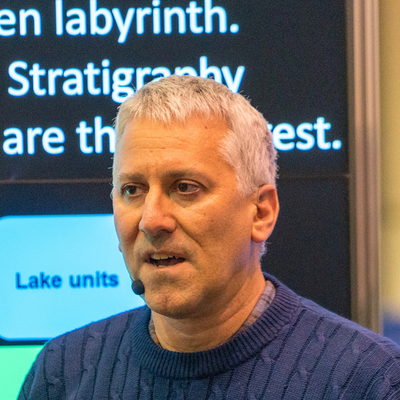
Planetary scientist, organic chemist, astrobiologist, field scientist. Works at Blue Marble Space Institute of Science. Champion of Titan exploration. Fascinated by life in Deep Ice. Studies the mysterious labyrinths and dissolution geology (karst) on Titan. Opinions expressed are my own. He/Him. #PlanetaryScience #astrobiology #chemistry #geomorphology #geology #karst #cryosphere #OceanWorlds #DeepIce #PlanetaryCaves
Public Key
npub1v0m8cmljfy9kze8fucetd2eqv3ptf7v9e092f8r5k2l0wpd485fs4vw4tq Profile Code
nprofile1qqsx8anudleyjzmpvn57vv4k4vsxgs45lxzuhj4yn36t90hhqk6n6ycprpmhxue69uhhyetvv9ujumt0d4hhxarj9ecxjmntrtjk2f
Show more details
Published at
2026-07-03T23:43:06Z Event JSON
{
"id": "fe0d3b5b380aefb18c2f615a6e056450c5f86a39008f5ca5eb71fce05695b9a7" ,
"pubkey": "63f67c6ff2490b6164e9e632b6ab206442b4f985cbcaa49c74b2bef705b53d13" ,
"created_at": 1783122186 ,
"kind": 0 ,
"tags": [
[
"t",
"planetaryscience"
],
[
"t",
"astrobiology"
],
[
"t",
"chemistry"
],
[
"t",
"geomorphology"
],
[
"t",
"geology"
],
[
"t",
"karst"
],
[
"t",
"cryosphere"
],
[
"t",
"oceanworlds"
],
[
"t",
"deepice"
],
[
"t",
"planetarycaves"
],
[
"proxy",
"https://deepspace.social/users/mike_malaska",
"activitypub"
],
[
"L",
"pink.momostr"
],
[
"l",
"pink.momostr.activitypub:https://deepspace.social/users/mike_malaska",
"pink.momostr"
],
[
"-"
]
],
"content": "{\"name\":\"Mike Malaska\",\"about\":\"Planetary scientist, organic chemist, astrobiologist, field scientist. Works at Blue Marble Space Institute of Science. Champion of Titan exploration. Fascinated by life in Deep Ice. Studies the mysterious labyrinths and dissolution geology (karst) on Titan. Opinions expressed are my own. He/Him.\\n\\n#PlanetaryScience\\n#astrobiology\\n#chemistry\\n#geomorphology\\n#geology\\n#karst\\n#cryosphere\\n#OceanWorlds\\n#DeepIce\\n#PlanetaryCaves\",\"website\":\"https://deepspace.social/@mike_malaska\",\"picture\":\"https://cdn.masto.host/deepspacesocial/accounts/avatars/109/323/249/860/858/915/original/035cc1133c1cb18a.jpg\",\"banner\":\"https://cdn.masto.host/deepspacesocial/accounts/headers/109/323/249/860/858/915/original/4e0255e283618c6b.jpeg\",\"nip05\":\"[email protected] \"}" ,
"sig": "18733c36acf3e48b0dffb2c5014e9ebb0c0ee0d7c6f89d650f0f45759dd5c6d39dfa4e7901a0727d3153536db0bd5248c8751f41e97acc03f6b2330d614478b3"
}
Last Notes npub1v0m8cmljfy9kze8fucetd2eqv3ptf7v9e092f8r5k2l0wpd485fs4vw4tq Mike Malaska View from spheroidally weathered granite blocks in the Alabama Hills National Scenic Area, California. https://cdn.masto.host/deepspacesocial/media_attachments/files/116/054/671/339/593/479/original/d1259023d888b068.jpg npub1v0m8cmljfy9kze8fucetd2eqv3ptf7v9e092f8r5k2l0wpd485fs4vw4tq Mike Malaska "Gosh, Mike, I bet running around in the desert you probably see a lot of wierd-looking plants, right?" Oh yeah. I present to you the Pagoda Buckwheat. This stands only about 20 cm high. It is very common along the roadside dropping into and climbing out of Panamint Valley on the road to Death Valley from Olancha, California. https://cdn.masto.host/deepspacesocial/media_attachments/files/116/047/425/244/997/761/original/9835f9bf1ad0cfa9.jpg npub1v0m8cmljfy9kze8fucetd2eqv3ptf7v9e092f8r5k2l0wpd485fs4vw4tq Mike Malaska Fine. I'll ditch the hashtag. npub1v0m8cmljfy9kze8fucetd2eqv3ptf7v9e092f8r5k2l0wpd485fs4vw4tq Mike Malaska Seriously? I can't post explanations? npub1v0m8cmljfy9kze8fucetd2eqv3ptf7v9e092f8r5k2l0wpd485fs4vw4tq Mike Malaska The edge of a canebrake in snowy woods. Orange County, North Carolina. #SilentSunday (Wkipedia entry on Canebreaks. A moist lowland native bamboo thicket common in SE of North America: https://en.wikipedia.org/wiki/Canebrake) https://cdn.masto.host/deepspacesocial/media_attachments/files/115/997/475/282/716/510/original/9269f45e560227eb.jpg npub1v0m8cmljfy9kze8fucetd2eqv3ptf7v9e092f8r5k2l0wpd485fs4vw4tq Mike Malaska Part 2: Tryptophan discovery: How do we know what we know? As promised, we gonna circle back on that tryptophan discovery. (For Part 1 in this series see here: https://deepspace.social/@mike_malaska/115653001232082594) And this gets to an even bigger question in #astrobiology (and life in general): “How do you know what you know?” We gonna dive deep into the analytical chemistry of that reported tryptophan detection, digging into the supplementary information analysis. [thread] #note1nz4…zjmv npub1v0m8cmljfy9kze8fucetd2eqv3ptf7v9e092f8r5k2l0wpd485fs4vw4tq Mike Malaska Why is the potential discovery of tryptophan in an asteroid sample such a big deal for #astrobiology? Gonna do a deep dive behind the headlines. For starters, here is a link to the discovery article: https://www.pnas.org/doi/10.1073/pnas.2512461122 thread time! npub1v0m8cmljfy9kze8fucetd2eqv3ptf7v9e092f8r5k2l0wpd485fs4vw4tq Mike Malaska Freeze expected tomorrow. I pulled the okra and put it by compost bin to chop later. Despite being late season, yanled out of the ground, and thrown in a pile awaiting a killing freeze, it is still trying! That's the spirit! Be like the okra. https://cdn.masto.host/deepspacesocial/media_attachments/files/115/521/233/918/285/085/original/766601edb9e47974.jpg npub1v0m8cmljfy9kze8fucetd2eqv3ptf7v9e092f8r5k2l0wpd485fs4vw4tq Mike Malaska My Incedible Superpower is spotting useful seedlings at the three or four-leaf stage. I'm a lazy gardner. I just let open pollinated stuff go to seed, sprout wherever, then spot and carefully transplant later. Here is an example bed I let idle. Over a year ago I had lettuce in here. There are a bunch of weeds, but one little lettuce seedling. Can you find it? #gardening https://cdn.masto.host/deepspacesocial/media_attachments/files/115/481/715/186/009/092/original/43eac647efe8f224.jpg npub1v0m8cmljfy9kze8fucetd2eqv3ptf7v9e092f8r5k2l0wpd485fs4vw4tq Mike Malaska Please RT. This link will help find the nearest foodbank in the United States. There is a search bar by zip code that provides a list of food pantries nearby. https://www.feedingamerica.org/find-your-local-foodbank npub1v0m8cmljfy9kze8fucetd2eqv3ptf7v9e092f8r5k2l0wpd485fs4vw4tq Mike Malaska By combining gases, adding some metal vapor, and using colored glass and blowing multiple tubes with different effects you can make some interesting signs. Like the neon sign for Dr. Kilzum pest control services. A lot of different colors and shapes on this 10 foot tall sign. Imagine blowing all those glass tubes! https://cdn.masto.host/deepspacesocial/media_attachments/files/115/274/209/558/995/744/original/e7295e4bab25cd90.jpg npub1v0m8cmljfy9kze8fucetd2eqv3ptf7v9e092f8r5k2l0wpd485fs4vw4tq Mike Malaska "Neon" is a generic term for sticking rarified noble gases (and maybe some metal vapor) in a tube and zapping it with high voltage alternating current. The high voltage strips off the outermost electron, and when it pops back in, it releases a photon at the corresponding quantum level. You get the same effect in an aurora. But noble gases are not corrosive. Here is a transparent display that show the different noble gases. https://cdn.masto.host/deepspacesocial/media_attachments/files/115/274/139/882/913/811/original/c4a7633f5e15fff0.jpg npub1v0m8cmljfy9kze8fucetd2eqv3ptf7v9e092f8r5k2l0wpd485fs4vw4tq Mike Malaska Yes. That previous piece is a neon art representation of the freeway system around downtown Los Angeles! Here is another very abstract large piece that was next to the LA nein piece. It was pretty big, maybe 2m on a side. https://cdn.masto.host/deepspacesocial/media_attachments/files/115/274/108/152/167/988/original/71b37b89e9f184c8.jpg npub1v0m8cmljfy9kze8fucetd2eqv3ptf7v9e092f8r5k2l0wpd485fs4vw4tq Mike Malaska Today I went to the Neon Museum of Modern Art in Glendale, CA. Very fun! Small, niche, and kitsch. They had lots of neat glowy stuff. I took many pix. For the ones that flash, I'll post a CW. The museum also has a workshop and for bigger bucks you can take a class to learn how to be a "neon bender". (Anyone want to guess what this abstract neon piece represents? Answer in next post.) [Thread] https://cdn.masto.host/deepspacesocial/media_attachments/files/115/274/073/515/159/732/original/9e34b7de95b8f041.jpg npub1v0m8cmljfy9kze8fucetd2eqv3ptf7v9e092f8r5k2l0wpd485fs4vw4tq Mike Malaska The NISAR mission's radar antenna has fully unfurled! Whoo-hoo! https://www.jpl.nasa.gov/news/giant-radar-antenna-reflector-on-nasa-isro-satellite-in-full-bloom/ npub1v0m8cmljfy9kze8fucetd2eqv3ptf7v9e092f8r5k2l0wpd485fs4vw4tq Mike Malaska Sunset on the Salish Sea. Lighthouse in Mukilteo, Washinton at sunset. https://cdn.masto.host/deepspacesocial/media_attachments/files/114/895/364/010/273/281/original/8e1c5c723f90079b.jpg npub1v0m8cmljfy9kze8fucetd2eqv3ptf7v9e092f8r5k2l0wpd485fs4vw4tq Mike Malaska Floating in Kraken Mare and looking for life has its own issues. What would you look for? You'd filter out any solids prior to analyzing the liquid so you dont gunk stuff up. Back to only looking at a handful of soluble molecules (srsly. I prepared this list for the Oceanus Calypso probe. These are not exciting molecules.) At low T, you'd want to look for molecular associations. Need in situ NMR, not destructive GC. I'm a very wet blanket regarding methane-based life. npub1v0m8cmljfy9kze8fucetd2eqv3ptf7v9e092f8r5k2l0wpd485fs4vw4tq Mike Malaska Imma push back on this way hard. Cryogenic methane is a truly lousy solvent. There is a VERY short list of organic molecules that will dissolve in it and let you shuttle energy-carrying molecules from one place to another. I challenge anyone to build up a biochemical cascade using ONLY cyclopropane and butane. (And I'm not even mentioning synthesis of A+B-->AB where AB is so insoluble it gloms itself to the enzyme active site - catalytic turnover of one.) npub1v0m8cmljfy9kze8fucetd2eqv3ptf7v9e092f8r5k2l0wpd485fs4vw4tq Mike Malaska The other recurring theme is that we need to improve planetary instrumentation and lower the detection limit. 1E3 cells per cm3 is just not good enough. We need to push to much lower. This will also help us explore Earth and can also help with medical technologies (just how "sterile" is that water, anyway?) So this article also serves as a call for better instrumentation for planetary #astrobiology. There will be more on that in a few weeks. (Stay tuned) \end thread. npub1v0m8cmljfy9kze8fucetd2eqv3ptf7v9e092f8r5k2l0wpd485fs4vw4tq Mike Malaska But the really big news (that got missed in the hype) is that TITAN IS HABITABLE. Our numbers show that it could support at least a small dog worth of biomass. (If you found a small dog on Titan you'd be pretty happy, right?) So the numbers, while low, will likely only go up as we get better data (more metabolisms) and better ideas of where to look. npub1v0m8cmljfy9kze8fucetd2eqv3ptf7v9e092f8r5k2l0wpd485fs4vw4tq Mike Malaska In micropockets, you can get concentration effects of about 1E6 as ice grains squeeze out non-water molecules. So you could get a hyperlocalized concentration. Which could push an effective cell count to 1E3 cells per cm3 which is now in range of current state-of-the art instrumentation. There are other ways to localize biomass too. Happens all the time here on Earth. npub1v0m8cmljfy9kze8fucetd2eqv3ptf7v9e092f8r5k2l0wpd485fs4vw4tq Mike Malaska Another thing is where are all those cells. Are they gonna be swimming around in the dilute-ass ocean? (Y'all should know I think the ocean of ocean worlds is the WORST place to look for life. Big. Dilute. Boring.) Life loves interfaces. Ice-ocean interface, ice-bottom interface, brinicles, cold-seeps (up or down), and especially micropockets in ice. (I'll be posting something exciting about micropockets in a few weeks. Stay tuned.) npub1v0m8cmljfy9kze8fucetd2eqv3ptf7v9e092f8r5k2l0wpd485fs4vw4tq Mike Malaska An analogy is that 1 person can live on 1 frozen pizza a day. So if you go into a grocery store and just count number of frozen pizzas, then that gives you an estimate of how many people that grocery store can feed, right? (Wrong. there are also frozen Turkey Pot Pies. Maybe other things, too. :) ) npub1v0m8cmljfy9kze8fucetd2eqv3ptf7v9e092f8r5k2l0wpd485fs4vw4tq Mike Malaska We only considered glycine fermentation. There are lots of other molecules that could be yummy microbe food (naphthalene is my favorite). But we only had really really good numbers for terrestrial microbes for glycine at low temperatures and high pressures. So that's a data issue. (The article is a call-out for low T, high P, microbiology experiments for funky metabolisms). npub1v0m8cmljfy9kze8fucetd2eqv3ptf7v9e092f8r5k2l0wpd485fs4vw4tq Mike Malaska If you dilute that out over the whole subsurface ocean, it give you numbers around 0.001 cells per cm3 (1E-3 cells per cm3) - that is one hundred time LOWER than medically sterile. That's bad news for Titan #astrobiology right? Well, not really. Here's why: npub1v0m8cmljfy9kze8fucetd2eqv3ptf7v9e092f8r5k2l0wpd485fs4vw4tq Mike Malaska In the Titan habitability calculation, we estimated the total amount of cell mass that could be supported by glycine fermentation based on the estimate glycine delivery from the top surface all the way through 100 km of ice into the deep subsurface ocean of Titan. And we came up with a small dog's worth of cell mass. Affholder et al. 2025 (open-access article): https://iopscience.iop.org/article/10.3847/PSJ/adbc66 npub1v0m8cmljfy9kze8fucetd2eqv3ptf7v9e092f8r5k2l0wpd485fs4vw4tq Mike Malaska Here are some numbers for comparison, in microbes per cm3 volume: Theoretical maximum limit: 1E15 cells per cm3 {this is based on the theoretical lower limit for microbial cells} Human body: about 2E8 cells per cm3 Deep Ice (2.5 km deep in Greenland ice sheet): 1E5-1E4 cells per cm3 Instrument detection limit: 1E2 cells per cm3 Medically sterile: 0.1 cells per cm3 npub1v0m8cmljfy9kze8fucetd2eqv3ptf7v9e092f8r5k2l0wpd485fs4vw4tq Mike Malaska "Habitability" is one of the most misused words in astrobiology. It is a usually a blurry concept used to justify a mission: “The [insert mission name here] will investigate the habitability of [insert world name here]”. More recently, habitability is becoming an actual quantitative and comparative concept. Specifically, how many microbes can exist in an environment? Here is an open-access article on Planetary Habitability: Mendez et al, Astrobiology 2021: https://www.liebertpub.com/doi/10.1089/ast.2020.2342 npub1v0m8cmljfy9kze8fucetd2eqv3ptf7v9e092f8r5k2l0wpd485fs4vw4tq Mike Malaska #astrobiology thread time! A paper came out a few weeks ago about "habitability". Specifically, the habitability of Saturn's moon Titan. We (am one of the co-authors) found that Titan's chemistry could support the equivalent biomass of a small dog. Is that....bad? (And what does "habitability" mean anyway?) Here is the press release from the University of Arizona: https://news.arizona.edu/news/saturns-moon-titan-could-harbor-life-only-tiny-amount-study-finds (Next post will have link to full paper) npub1v0m8cmljfy9kze8fucetd2eqv3ptf7v9e092f8r5k2l0wpd485fs4vw4tq Mike Malaska A symmetrical scene on a #SilentSunday on the shore of the Salish Sea. Mukilteo, Snohomish County, Washington State https://cdn.masto.host/deepspacesocial/media_attachments/files/114/294/456/653/097/449/original/a46cb6321486abff.jpg npub1v0m8cmljfy9kze8fucetd2eqv3ptf7v9e092f8r5k2l0wpd485fs4vw4tq Mike Malaska As the Huygens probe descended, it took lots of pictures on its way down to the surface. Those are just a gold mine of information. Here is a really fun movie that we call the "bells and whistles" version. It is incredibly information rich. I love watching this over and over. You can see little cartoons showing probe orientation spin, telemetry data, instrument sequences, and images. I love to marvel at the planning that made this happen. https://science.nasa.gov/resource/titan-descent-data-movie-with-bells-and-whistles/ npub1v0m8cmljfy9kze8fucetd2eqv3ptf7v9e092f8r5k2l0wpd485fs4vw4tq Mike Malaska Ahhhhh. That's still a mystery! You will read in Wikpedia or some of the literature that it is water ice. But actually, we don't know. It could be ice, or other things: frozen benzene, solid HCN, mixed solid organics. We do not have detailed spectra or other chemical analysis of those rocks vs the sands. (Personally, I think it's probably ice, but I want better proof.) (The dark sands I'd lean my guess towards probably organics.) It is good to have mysteries! Fun! Explore! npub1v0m8cmljfy9kze8fucetd2eqv3ptf7v9e092f8r5k2l0wpd485fs4vw4tq Mike Malaska So. Streams or floods, rocks eroding, sorting. Faster than getting covered by atmospheric organic molecules. Got it. But what are those rounded rocks made of? npub1v0m8cmljfy9kze8fucetd2eqv3ptf7v9e092f8r5k2l0wpd485fs4vw4tq Mike Malaska And also what you DON'T SEE. We don't see a uniform snowscape blanket of organic molecules everywhere. That tells us that whatever geological processes happen are faster than covering by organic molecule fallout. That fallout happens at a rate of about same as dust builds up in your house if you have a clothes dryer in your house. Max 100 m per Gyr: 0.1 m per Myr, 0.1 mm per kyr or 0.1 microns per year. Give or take an order of magnitude. So geology happens on Titan. It's not boring. npub1v0m8cmljfy9kze8fucetd2eqv3ptf7v9e092f8r5k2l0wpd485fs4vw4tq Mike Malaska Just from this surface image, you can figure stuff out. All those rocks (whatever they are made of - that is still a mystery), are all rounded, and the same size. Rounding suggests erosion, those "rocks" banged together repeatedly. Likes rocks in a river or shore (hint-hint-hint). And sorting by some type of process where bigger rocks dropped out somewhere else, and smaller rocks or pieces dropped somewhere else. Either a flood deposit or a stream deposit. npub1v0m8cmljfy9kze8fucetd2eqv3ptf7v9e092f8r5k2l0wpd485fs4vw4tq Mike Malaska On January 14, 2005 just over 20 years ago today, the Huygens probe touched down on the organic-rich surface of Saturn's moon Titan. Here is the scene from Titan's surface. https://photojournal.jpl.nasa.gov/catalog/PIA07232 Scientists (I'm one of those) have been analyzing this image and the other descent images from the probe for 2 decades. What have we learned from the probe images about the surface of enigmatic moon? [Thread] https://cdn.masto.host/deepspacesocial/media_attachments/files/113/832/593/596/621/056/original/e8f4b92179664f02.jpg npub1v0m8cmljfy9kze8fucetd2eqv3ptf7v9e092f8r5k2l0wpd485fs4vw4tq Mike Malaska For example, if someone found a single-dose cure for Alzheimer's they could probably name their price. Market would easily support $100k per person in my guesstimation. In US, there are 500,000 new cases of AD per year. So that is a whopping $50B potential market. I can't see the public sector allocating that much even if it was only just to break even economically. (Current public funding only about 10% of that and doesn't have that goal.) npub1v0m8cmljfy9kze8fucetd2eqv3ptf7v9e092f8r5k2l0wpd485fs4vw4tq Mike Malaska Would agree sorta. Some of these issues are baked into the system. However, antibiotics, antifungals, and antiparasitics do produce cures. Nobody would buy a bacterial-stat when a bacterial-cide was available. Same with other drugs. All things equal, a cure for cancer or Alzheimer's or whatever would always outcompete a long-term treatment for same disease. In this case the competitiveness works for you to incentivise better treatments. npub1v0m8cmljfy9kze8fucetd2eqv3ptf7v9e092f8r5k2l0wpd485fs4vw4tq Mike Malaska Costs for clinical trials should be the same for either private or public sector. I honestly don't know what drives clinical costs. I've always assumed it is the personnell costs of record-keeping, administration developing protocols, dealing with Investigational Revew Boards, etc. (I also dont have a good handle on R&D costs spent vs. drugs approved for public sector efforts. Any ideas?) npub1v0m8cmljfy9kze8fucetd2eqv3ptf7v9e092f8r5k2l0wpd485fs4vw4tq Mike Malaska Sorry. I wasnt super-clear in explanation. Was assuming a total market potential of $1B per year, but assumed the successful drug would only capture 50% of that market averaged over 16 years. So $500M per year actual sales over 16 years gives $8B total which is just enough to cover costs. No profit. Means you need $1B per year potential to even think about a program. (Which, as you stated, economocally limits targets.) npub1v0m8cmljfy9kze8fucetd2eqv3ptf7v9e092f8r5k2l0wpd485fs4vw4tq Mike Malaska ...the other implication is that you gotta make up for that initial cash outlay on the back end. So assume 16 years of exclusive patent period and average during that period of 50% market penetration you need to have a $1B per year drug to make up for your initial costs. Big question: Is there a $1B per year driving need RIGHT NOW for a new antibiotic? (Remember, there are other generic antibiotics, insurance companies will want to try those first.) npub1v0m8cmljfy9kze8fucetd2eqv3ptf7v9e092f8r5k2l0wpd485fs4vw4tq Mike Malaska So, if you want new antibiotics, someone's gotta: 1) pony up a several BILLION dollars of dedicated R&D effort for just this. 2) find some way to improve that 96% failure rate. That 96% is ingrained in every pharma scientists brain. Keeps us humble. There is always a "bold new paradigm to accelerate drug discovery" that never moves the needle. npub1v0m8cmljfy9kze8fucetd2eqv3ptf7v9e092f8r5k2l0wpd485fs4vw4tq Mike Malaska (those are very old numbers, btw. Prolly double now.) At each step, about 50% attrition. (This is why press releases finding something active #InMice is so silly.) So it COSTS $620 million to find a new drug if everything works. How much do pharma companies actually SPEND to find a new drug? (So include failure costs) Turns out about $8B per drug. (Reported R&D costs per new drug approval) npub1v0m8cmljfy9kze8fucetd2eqv3ptf7v9e092f8r5k2l0wpd485fs4vw4tq Mike Malaska Former medicinal chemist here. Developing drugs is really hard. We have a 96% failure rate. Here is some math. Assume $300K FTE rate per scientist. Find a preclinical candidate: $15M Tox testing: $5M Phase 1 clinical trials (safety in healthy subjects - is it safe?): $50M Phase 2 clinical trails (efficacy in diseased subjects - does it work?): $250M Phase 3 clinical trials (liability): $300M Total: $620M if everything works. But, 96% failure rate. npub1v0m8cmljfy9kze8fucetd2eqv3ptf7v9e092f8r5k2l0wpd485fs4vw4tq Mike Malaska haha! Perfect timing! I just switched my field compass' declination offset just yesterday! Here is a handy calculator from NOAA where you can enter the target lat lon (for a future field expedition) and get the declination offset: https://www.ngdc.noaa.gov/geomag/calculators/mobileDeclination.shtml#WMM npub1v0m8cmljfy9kze8fucetd2eqv3ptf7v9e092f8r5k2l0wpd485fs4vw4tq Mike Malaska Picnic Point County Park, Snohomish County, Washington. #SalishSea #SilentSundays https://cdn.masto.host/deepspacesocial/media_attachments/files/113/619/882/609/347/835/original/9254c54d994dbd89.jpg npub1v0m8cmljfy9kze8fucetd2eqv3ptf7v9e092f8r5k2l0wpd485fs4vw4tq Mike Malaska #SilentSunday Orange County, North Carolina. https://cdn.masto.host/deepspacesocial/media_attachments/files/113/341/361/215/397/732/original/9f4db8c29e9b9841.jpg npub1v0m8cmljfy9kze8fucetd2eqv3ptf7v9e092f8r5k2l0wpd485fs4vw4tq Mike Malaska All these ideas are described in: Waite et al (2024) "MASPEX-Europa: The Europa Clipper Neutral Gas Mass Specteometer Investigation." Space Science Reviews 220:30. Open access (free!!!!) here: https://link.springer.com/article/10.1007/s11214-024-01061-6 (Heads up its 126 pages long.) Specifically, ceck out Europa MASPRX Science Objective 3: "Search for potential biosignatures in the Europs enviroment." Good hunting! npub1v0m8cmljfy9kze8fucetd2eqv3ptf7v9e092f8r5k2l0wpd485fs4vw4tq Mike Malaska Some fatty acids (lawyer warning here: "this only applies to satutated linear (unbranched) fatty acids in certain life forms on Earth.") have a 2C homologation pattern because of how they were built up by enzymes. (Fatty Acid Synthesis - FAS pathway. Although there is another pathway at high pressures.) That might give a pattern in.the MS that could be considered a biosignature - a hint of something exciting. npub1v0m8cmljfy9kze8fucetd2eqv3ptf7v9e092f8r5k2l0wpd485fs4vw4tq Mike Malaska Other clues are that a few different pieces get assembled up into bigger things. When amino acids get assembled up they become proteins and enzymes. Assembled up, nucleotide bases become DNA and RNA. Some small structures (CH2CH2) and isoprenyl get built up into membrane molecules. (I like membrane molecules.) When you smack them with an MS. You see these repeating breakdown chunks as the links sometimes fall apart because the links and connectors are weaker. npub1v0m8cmljfy9kze8fucetd2eqv3ptf7v9e092f8r5k2l0wpd485fs4vw4tq Mike Malaska One clue, is that there are many many possible structural isomers for a molecule of a given size. Abiotic chemistry makes a (sorta) random mess. In contrast, biology uses molecular things. So you might see a few key molecules, but lots of them. Lower diversity. As an example, go into a forest after a windstorm, wood of all sorts of lengths lying everywhere. But go into a lumberyard, and sizes and lengths are pretty standard: 8ft, and 12 ft. Standardized stuff makes building things easier. npub1v0m8cmljfy9kze8fucetd2eqv3ptf7v9e092f8r5k2l0wpd485fs4vw4tq Mike Malaska Europa Clipper is a mission to chatacterize the "habitability" of Europa. That is its goal. The team has been very very careful to not claim that it is looking for life. It is effectively being pitched as an early precursor #OceanWorld #astrobiology mission. But...if life were there and evidence was detected by the spacecraft, what instruments might give the hint of a biosignature? That might be the mass spectrometer MASPEX. What could it detect? npub1v0m8cmljfy9kze8fucetd2eqv3ptf7v9e092f8r5k2l0wpd485fs4vw4tq Mike Malaska Europa Clipper unfolded its solar panels! https://blogs.nasa.gov/europaclipper/2024/10/14/solar-arrays-on-nasas-europa-clipper-fully-deployed-in-space/ npub1v0m8cmljfy9kze8fucetd2eqv3ptf7v9e092f8r5k2l0wpd485fs4vw4tq Mike Malaska Europa Clipper launch live stream: https://www.youtube.com/live/lQToTWKwtuw?si=hIJiB7ZE7j5hxFTE Launch at 12:06 EDT. Less than 1 h! Everything looks good now! npub1v0m8cmljfy9kze8fucetd2eqv3ptf7v9e092f8r5k2l0wpd485fs4vw4tq Mike Malaska (Read last sentence in 'Shigella-classification' section in the Wikipedia entry) https://en.m.wikipedia.org/wiki/Shigella npub1v0m8cmljfy9kze8fucetd2eqv3ptf7v9e092f8r5k2l0wpd485fs4vw4tq Mike Malaska Also "taxon in disguise" where they figure out later that things fit together differently. A great example is genus Shigella (one species causes dysentery. Very bad.). Turns out...the whole genus is (are?) just strains of E coli. So it should be be reclassified. But there is so much negative publicity (the dysentery thing), that it would be dangerously confusing to reclassify it. So it remains as a neat factoid for those "in the know." npub1v0m8cmljfy9kze8fucetd2eqv3ptf7v9e092f8r5k2l0wpd485fs4vw4tq Mike Malaska Geological Society of America pre-conference field trip thread! Ever wonder what a GSA preconference #geology field trip is like? Want to see some of the geological wonders of Southern California? As one of the optional field trips for #GSAConnects2024, our trip went to Anza Borrego/Salton Sea area and was designed to highlight key geoscience educational areas along the way. The goal was to share techniques for teaching and explaining geoscience concepts to students and the public. [1/15] https://cdn.masto.host/deepspacesocial/media_attachments/files/113/217/556/635/778/181/original/62e464f9100bc4ff.jpg npub1v0m8cmljfy9kze8fucetd2eqv3ptf7v9e092f8r5k2l0wpd485fs4vw4tq Mike Malaska Ever wonder if there are analogs for Saturn's moon Titan in Death Valley? Would you like to try a clickable map choose-your-own-adventure-style StoryMap? I got you. Right here: https://uploads.knightlab.com/storymapjs/309aee613c9ca5466ff4084b009c1549/analogs-of-saturn-s-moon-titan-in-death-valley-national-park-draft0/index.html npub1v0m8cmljfy9kze8fucetd2eqv3ptf7v9e092f8r5k2l0wpd485fs4vw4tq Mike Malaska Heya #mapstodon , Has anyone used StoryMap JS? Reccomend? Any good tutorials or tips? npub1v0m8cmljfy9kze8fucetd2eqv3ptf7v9e092f8r5k2l0wpd485fs4vw4tq Mike Malaska I just captured a one-in-a-million image. In the woods just off our front deck. I think it wants me to go with it to Narnia. https://cdn.masto.host/deepspacesocial/media_attachments/files/112/962/755/219/091/509/original/a632d06d2220117e.jpg npub1v0m8cmljfy9kze8fucetd2eqv3ptf7v9e092f8r5k2l0wpd485fs4vw4tq Mike Malaska No complex life without oxygen? <Loricifera has entered the chat> https://en.wikipedia.org/wiki/Loricifera npub1v0m8cmljfy9kze8fucetd2eqv3ptf7v9e092f8r5k2l0wpd485fs4vw4tq Mike Malaska Blackwood Farm Park, Chapel Hill, North Carolina. #SilentSunday https://cdn.masto.host/deepspacesocial/media_attachments/files/112/866/084/630/834/215/original/61da7ec1fcc2d761.jpg npub1v0m8cmljfy9kze8fucetd2eqv3ptf7v9e092f8r5k2l0wpd485fs4vw4tq Mike Malaska I let my lettuce bolt last year. Chopped it in fall before I threw into compost tumbler. In early spring, I found volunteer little lettuce-lings at the three-leaf stage where I had chopped it up. Moved them to a bed and they did just fine. (Pretty sure it was Tropicana lettuce variety, btw.) Big lesson: Let stuff bolt in summer/fall. Chop up in different areas just before putting into composr. Look for volunteers in those areas in very early spring. https://cdn.masto.host/deepspacesocial/media_attachments/files/112/626/739/027/141/074/original/ccf7f9b6d7591562.jpg